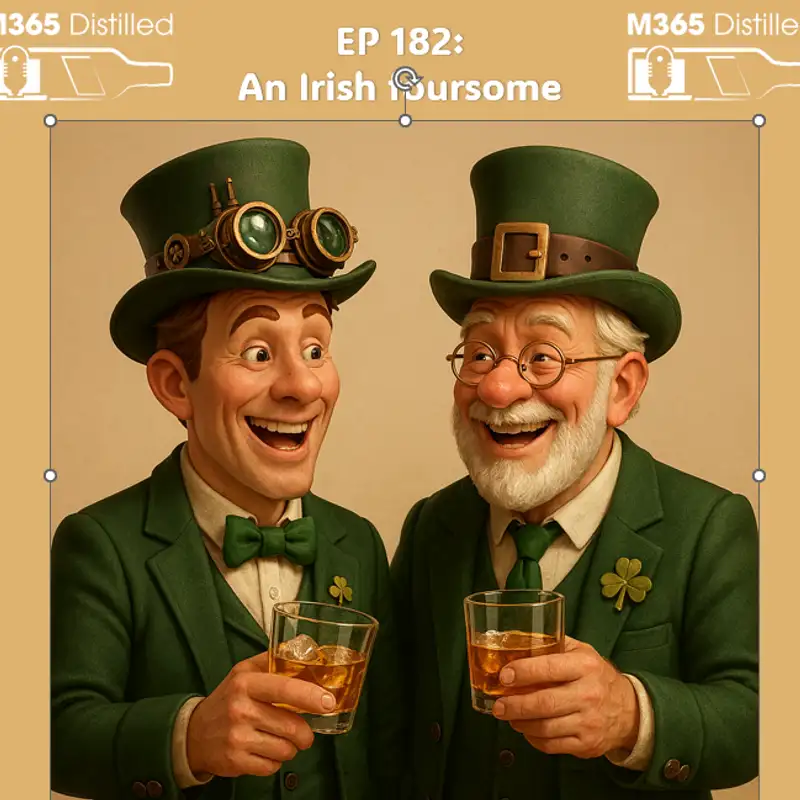
EP 182: An Irish foursome
Hey. Hey.
Speaker 2:I need to stop pulling out my nose hair.
Speaker 1:Is it... It could be worse.
Speaker 2:It could be worse. Hell yeah.
Speaker 1:Hairs lower down in your body.
Speaker 2:Yeah. My my my toe here. That reminds
Speaker 1:me of the Irish Dublin University. So there was an international
Speaker 2:conference on
Speaker 1:hair within the body and the Americans came along and said actually we've been doing some research around the nerve endings on hair and it's really very isolated in the skin. And the Dublin University came and said, actually, we've been doing some really interesting hair hair work and how connected in the body. And every piece of hair is connected to your eyes. And they went, what? Says, look, we've we've tried it.
Speaker 1:If you take if you take somebody's pubic hair and pull, the eyes water. Sorry. It was... There we go. Okay.
Speaker 1:So... But but, yes, you should stop pulling your hair out the nose. But both both your PB care and your nose hair will make your nose run.
Speaker 2:Yes. Yes. Yeah. Yeah. So be...
Speaker 2:Before we were recording, I was just, getting a
Speaker 1:Sniffle.
Speaker 2:Yeah. I was getting
Speaker 1:for a sniffle.
Speaker 2:Yes.
Speaker 1:I think it's just too much Coke. Maybe. New rule. No Coke until after the podcast. Damn.
Speaker 2:Damn. Actually funny. So my daughter, who's now 14, she got some, jewelry from my ex wife back from when she was young. And one of them is like a ring with a heart on it, and you can open it up to to... And it's like a little hiding space where you can put some some stuffing.
Speaker 2:Like perfume? Yes. Or a dried flower.
Speaker 1:Or a dried flower for her.
Speaker 2:No reason. Yes. I agree. And and basically, so I'm taking my daughter to Pukelpop. I said, you can bring the ring.
Speaker 1:You're gonna see the Foo Fighters?
Speaker 2:I don't know. We're going on Sunday. Oh. So we're going to see all the bands that she likes that I've never heard of like Somers and someone Larson.
Speaker 1:Oh, I know Larson.
Speaker 2:Tyler the maker creator. I can
Speaker 1:know that one too. Yeah.
Speaker 2:Never heard
Speaker 1:of these but yeah. Marijn, you were trying to find an Irish song.
Speaker 2:Yeah, yeah, yeah because it's it's Saint Patrick's Day, Saint Patty's Day.
Speaker 1:It's Saint Patty's Day, yes, Saint Patty's That means we'll be drinking some Irish water.
Speaker 2:Yes. We've we've got a few lined up. Interesting.
Speaker 1:This might be one of those sessions. We've got four really very interesting Irish whiskies, and I promise Marijn, they'll only have to take a little teaspoon of each one.
Speaker 2:And actually, we're talking about five, six, basically six different
Speaker 1:Five areas? Yeah. Yes. So that's Okay.
Speaker 2:And the pubic area is not one of them?
Speaker 1:No. Thankfully. Today, anyway, it could be different.
Speaker 2:We covered that already. We did. Yes.
Speaker 1:So that's true. Alright. So let me So we could
Speaker 2:do a little
Speaker 1:Travel mix and plans. You're off to Seattle. You know why. But you won't be able to tell us.
Speaker 2:Yeah. I can... I... Of course.
Speaker 1:Can. You won't be to tell us anything you hear.
Speaker 2:Oh, no. No. No. No. MVP summit.
Speaker 2:Everything is not only NDA. It's also under embargo. Embargo at
Speaker 1:least for two hours because they just don't trust MVPs anymore not to say anything.
Speaker 2:It was so weird. Two weeks ago, there was a super secret meeting.
Speaker 1:Yes.
Speaker 2:And there was on the agenda. So it was... It it didn't say what it was about. It was just like super secret meeting. So a bunch of people went in there.
Speaker 2:I can't say what it's about. It's it's it's out now, but I can't say what it's about. But, basically, everyone was there. It was like super secret. It was NDA under embargo.
Speaker 2:And like literally four hours later, I see messages about it appear on LinkedIn and Twitter from just people. Wow. And I'm like, what? What is happening here?
Speaker 1:So you've not officially heard it released yet. People were breaking the rules.
Speaker 2:Yeah. Oh, no. No. Absolutely. They said, no.
Speaker 2:This is not... This is only gonna come out in in ten days or in two weeks or something, but we already wanna give you guys head... Heads up. But I mean, I've I've seen things.
Speaker 1:Amazing. Seeing things, baby. Seeing things. But I remember I remember a friend of ours, I'm not gonna go mention him because he's a well respected MVP, and he made a mistake of having received something from Microsoft and publishing it, and the lawyers hit him left, right and center. I mean, he sincerely apologized and all that kind of stuff.
Speaker 1:Yeah. But they do follow that kind of stuff up.
Speaker 2:Yeah, So, I don't know what's going to happen because it was quite big news.
Speaker 1:Yeah, yeah. Except if
Speaker 2:you're living in The UK or The EU.
Speaker 1:Yeah, yeah, let's not go there.
Speaker 2:Anyway, so...
Speaker 1:Yeah. So you'll be hearing
Speaker 2:a bunch of stuff to
Speaker 1:talk about.
Speaker 2:I'll be at summit, MVP summit. I'm gonna create a life... Not not a live vlog.
Speaker 1:You know? But about to commit yourself to this now.
Speaker 2:Oh, yes. Yes. Yes. Yes. I'm gonna create a video like what is it like to be an MVP at MVP Summit?
Speaker 2:So it's gonna be interesting. And then it's funny. On Saturday, I'll be back. And on Monday, I'm leaving for Sarajevo for the Adriatic Tech Conference. Nice.
Speaker 1:Yes. There we go. That's cool then.
Speaker 2:I'll be back on Wednesday.
Speaker 1:You weren't even there trying to get your jet laggards sorted out. No. Exactly. Is it a different time zone in Sarajevo? No.
Speaker 1:Okay.
Speaker 2:So I don't think so.
Speaker 1:Worst jet lag I ever had
Speaker 2:was flying. Yugoslavia. So it's basically like Croatia. And... Yeah.
Speaker 1:Worst one I ever had was going, from minus seven hours London time to plus two hours London time in one flight. And I didn't never... You've seen me. Jet lag doesn't bother me. I've been really able to travel all my life really well.
Speaker 1:But that one, that was really screwed my head up. Yeah. And I think it's something to do with flying over your own time zone. I listened to other day, oh there's London, and then I was suddenly two hours ahead going from seven hours behind. I mean I've done the twenty four hour stuff, I've done out to you know China and things and didn't seem to bother me
Speaker 2:too Lose a day.
Speaker 1:Yeah, so I'm speaking tomorrow, Thursday, at the AI conference in Amsterdam, so completely sold out folks. If we see you there come and say hi, trying to sort AI out from chaos to roadmap.
Speaker 2:Where is it in Amsterdam? No idea. Okay.
Speaker 1:It's... I tell you where it is. It's over the bridge. So it's over the water from the central station. It's in that part of it.
Speaker 1:Know the swing on top of the building? Yeah, do know where it is, this is where the Google was when I went to Google, I can't remember the name of the venue. Sorry. That's good. Alright, so it's St Patrick's Day.
Speaker 1:We're going to talk about collaboration, the Irish are amazingly good at. If you've been to Ireland, everybody likes to collaborate in a pub and talk and chat and be friendly.
Speaker 2:It's it's amazing. Super fun in in in pubs. Yeah. Absolutely.
Speaker 1:Dublin and and all that kind of stuff. So we have four unusual whiskies to have a a little wee snifter off and celebrate Paddy's Day. So we hope you've got things planned for today, and you're gonna go and do your stuff and then take it from there. Of course, it's not really Paddy's Day, but we'll be releasing this on Paddy's Day.
Speaker 2:Yes.
Speaker 1:So we'll be drinking with you guys in spirit,
Speaker 2:literally. Yes. Spirit in spirit. Yes.
Speaker 1:But we want to talk about collaboration.
Speaker 2:Yes. It's... Because you have a super interesting Well, I have
Speaker 1:a session. It's actually put forward a few times. So if we do get a chance to do that, we'll take it from there. The session is actually a collaboration method... Measured.
Speaker 1:It's not just a feeling.
Speaker 2:And to be specific, this is collaboration between people or is this also human to agent collaboration?
Speaker 1:No. It's, people collaboration.
Speaker 2:Yes. The secret ingredient is people.
Speaker 1:Yeah, is. Absolutely. So it's one of the overused words in kind of modern organisations. Yeah, we collaborate together. We work as a team.
Speaker 1:We do that kind of That
Speaker 2:always reminds me of that old Dilbert cartoon where the boss goes like, yeah, I collaborated twice today.
Speaker 1:Yes. But, the real question that was posed at me, was how do you know it's actually happening? Yeah. How do you know that your company is collaborating? You do a huge adoption program and training and then you go, how do we know it's happening?
Speaker 2:Or even better, you start working agile or you go scrum or whatever because that's going to improve collaboration, that's going to improve the way we do things. How do you measure if it's going well?
Speaker 1:Well, of the things I mean, we'll go into five areas that I think are worth looking at. But as an overview, sort of how do you move from a sort of vague aspiration to something that is observable, something that is behaviour and something that's actionable? So that's the kind things we're looking at. Measurable, of course, is the key one on there. And effectively, if we think about collaboration, then it actually drives performance, it drives adoption and innovation in your organisation.
Speaker 1:So knowing that it's there is important.
Speaker 2:Yeah. And it's not being more busy. That's not it.
Speaker 1:It is actually to an extent, but it's being busy with other people. Yeah. So can I
Speaker 2:break Because you you for a reason, like for a good business reason with other people? Yeah.
Speaker 1:Yeah. With some goal. Yeah. You know? And so what I want to do is to identify five areas of measurement and then we'll look at whether they make sense or not, and we'll break them down.
Speaker 2:Yes. And also being 100% collaborative might also not be a goal because then you don't have thinking time on your own or time to actually do something, create something.
Speaker 1:I think so. I mean there is a Microsoft collaboration score. Oh yes, right. What they're basically looking at there is how often you meet people and whether it's in your calendar and you know whether you meet them online or offline. So it's about face to face stuff which is okay but it's not collaboration because you're not measuring value you're measuring action of meeting together.
Speaker 2:Yeah it's like oh I've seen you like check it off and yeah.
Speaker 1:Yeah. So you get positive marks for having meetings together and actually sharing information on email and messages.
Speaker 2:But is it effective? That's
Speaker 1:true and you get negative marks if you do things like check your email when you're in those meetings. Oh
Speaker 2:that's true.
Speaker 1:It's looking at those kinds of things. So it's only looking at actions and that's no way of measuring it, that's just something you did. I actually want to try and come up with ways of saying you had a meeting and I can prove, I can see that it made a change. Yes. And so I want to try and measure those that make a change.
Speaker 1:So that's what I'm trying Yes. To
Speaker 2:Because, basically, one of the things that I'm... So I'm I'm collaborating with an organization. And every morning, we do a stand up where everybody talks about all the bits and things that they've done the day before and that they're gonna do today. And it's basically extremely boring because it's five people talking about their own projects that I have nothing to do with, but it's also boring for them because they also need to listen to other people doing that. But the thing is that is the place where we are also talking about, I kind of stuck with this, or I kind of need help with this, or how would you do this?
Speaker 2:Agile.
Speaker 1:Yeah. You're talking about work. Yeah. Exactly.
Speaker 2:Yeah. So so that bit is super interesting.
Speaker 1:Yep. It... It's work. It's about making sure things are moving forward. Yeah.
Speaker 1:And there'll be a scrum master in there that said, if you're stuck, talk to me and I'll help you out. Yeah. And they will then start to try and remove problems so you can continue with work. Yeah. So work...
Speaker 2:But this this should supposedly be like what ten minutes or something? We we always... It always takes us an hour.
Speaker 1:Really? Yeah. Are you going to too much detail?
Speaker 2:Oh, yeah. Absolutely. Because that is that is the place where we bounce off ideas and where we sometimes show things briefly and...
Speaker 1:Yeah. Okay. Then it's a kind of retrospective. Okay.
Speaker 2:Yeah. It's also like a knowledge sharing collaboration. Okay. That's fine. Yeah.
Speaker 1:So, I think that's valid. Yeah. Alright. But it's it's all about work. So collaboration should generate work, generate good work, allow work to move forward.
Speaker 1:So my first criteria
Speaker 2:Wait. Wait. Wait. Wait. Wait.
Speaker 2:So Are
Speaker 1:you gonna argue with everything? No. No. No. No.
Speaker 1:No.
Speaker 2:I'm I'm just trying to see if I if I get it. So collaboration is That's fine. Is... Does that mean that in that collaborative moment, we're gonna we're gonna agree that I need to write this document, and then I go off and write the document? Or...
Speaker 2:Okay.
Speaker 1:No. That's what you do. You agree. But how do you know that you've done it? So the value out of those meetings and collaboration sessions is the result of it.
Speaker 1:So that's what I'm looking at doing. So I've got this session it's called work visibility. Yeah. So I know that work was done. Yeah.
Speaker 1:That's the difficult thing at the moment so I had a great conversation actually with somebody two days ago where we said look within this organisation we're really really good at solving problems we have the right mix of people, we all sit together and we say hey that's the problem, this is what we need to do. But what we're really bad at is fixing the problem and actually going away and doing it, all right delivering And that's the definition, that's a measurement of collaboration. Yeah. So you worked out what the problem was, worked out where you were going and then you did it. So the measurement is not that you spent time together, that you even came up with a great idea, but that idea was then delivered or that work was generated from it.
Speaker 2:Yes. And of course the work that is generated from the I wrote that document, that really doesn't have value unless it's put into some kind perspective of the thing that needs to happen around it. Like for example, if that document is an invoice, then the value is that it's sent out and that we get the money.
Speaker 1:It's the value. Yeah. So did did those six people deliver that piece of work or did those six people just talk about it and not deliver that piece of work?
Speaker 2:Yeah. So for customer work, it's gonna be something I create and then we put it into ready for review.
Speaker 1:Yeah, just a second. I'm sorry. No, no, I know where you're going with this. You're taking it to an extent, but we've got to remember the goal here. The goal is do we collaborate and how well we collaborate.
Speaker 1:So we talk about stuff and then we deliver stuff.
Speaker 2:And the delivery could be I wrote this, let's review this, customer agrees, then we mark it as done.
Speaker 1:Could be. Could be that I'm going to contact this company and find out whether they're interested in buying our product.
Speaker 2:Yeah. Alright. So basically, you introduced me a few years ago with the definition of done. Yes. And I love that concept.
Speaker 2:So does that also play a role in
Speaker 1:this? As in some respects. So let's not go too overboard. We... You're taking it out of context in some respects.
Speaker 1:It's because the collaboration, what you're measuring is collaboration. You're actually measuring the process. Yeah. You're not measuring whether we completed all the work we had online. That's not what we're measuring.
Speaker 1:We're measuring whether collaboration generated some value. So you can have a meeting. Yeah. That meeting can be about anything. Need to write a document.
Speaker 1:I need to define this process. I need to set up a conference. I need to whatever. So then there'll be certain tasks that we work together on. So I might well create that document but if I'm collaborating on that document I also need to see that other people worked on that document.
Speaker 1:That they all got together and we used, we innovated together and we got better from the part. So that's much more difficult to try and do. So it's about work visibility. So are we collaborating together and here's something being... Can we see that those...
Speaker 1:That you are moving forward with things?
Speaker 2:Yeah. So the quality of the work delivered is not part of the equation. No. Okay.
Speaker 1:But you assume that if three people worked on a document, you have a better quality document?
Speaker 2:Yes, because it's got more views, more eyes on it and more opinions. And if
Speaker 1:that document is shit, but you have some other form of validation, it'll get sent back to the team to work on the same as that project plan really does not work, try again.
Speaker 2:Yeah, but I mean in our approach here we're not measuring that, we're measuring the level of collaboration.
Speaker 1:Correct.
Speaker 2:Yeah, we're not measuring the outcome.
Speaker 1:I was recently in a process where we wanted to have a centralized priority list and so everybody got together and said 'hey I need this doing and I need your help to do this and I need this doing and need that doing and everything else' and so that was created. But it was created with one person having individual meetings with everybody else. Okay? And then creating a list of everybody's input. Yeah.
Speaker 1:And then at some point they sat down and went, oh I think that's more important. All right? None of that work was done collaboratively, in my opinion. Okay? Because none of those people actually spoke to each other, they just spoke through one individual and that individual then defined the priority.
Speaker 2:So it's more like a star diagram with one center
Speaker 1:Yes, agree. Now what's missing from there is any form of ownership. Has been created is everybody still wants to do their piece of work. That's the one that I'm accountable for, so I want to move that forward without understanding why something else in that priority list is important because nobody did it together and I didn't talk to people that were part of something else. I do meet them in other circumstances now in terms of managing that work, but everybody feels disconnected because they were not collaborating over the work.
Speaker 1:The work was actually controlled by somebody else.
Speaker 2:Gotcha.
Speaker 1:Settled. So in that, in those... So what I want to know is whether five people generated that list as one. They didn't. Five people generated that list on individual star based one person in the middle.
Speaker 1:So to me that's not collaboration. So I wanted to be able to monitor, make sure that that is there. Work is created, but is it good work? But it's better work if it was collaborative. And we're learning that now.
Speaker 1:We're going, hey, come on, just a minute. I didn't even know why we have these priorities set because you kind of just put priorities in. And so I don't feel ownership for those priorities because you've basically done by you. Yeah. It was driven by an individual.
Speaker 1:So it's really important to understand that a group of people created a piece of work that defines collaboration. Yes, we are gonna
Speaker 2:try to measure how well they collaborate on that bit.
Speaker 1:That's what we're going to try and do. That's what we're doing. That's how we measure it. I actually have a solution on what we're going to do, but you know that we haven't, that's maybe a different podcast. But it's all to do with AI prompts.
Speaker 1:You can use an agent to be able to go in and find out whether that piece of work was created with input from all those kinds of people through messages, emails and So
Speaker 2:just a little bit like the planner program agent, what's it called? Project manager agent kind of does is goes and checks if things are
Speaker 1:set Yeah. Up and What this is actually agent is going to do, and it does do, I've actually got it working. It actually just goes through and assesses over your last period of a week or two weeks or whether how many times you collaborated and whether I have evidence that what you collaborated about was actually generated.
Speaker 2:Okay. Okay.
Speaker 1:So that's what it's doing. And what I want to do is refine that a little bit, to actually give you the opportunity to go, well, had that meeting and this was what was generated just because you can't find it, it wasn't there. So... But I'm I'm trying to keep it simple at the moment. The idea really is to try and come up with a score.
Speaker 2:But Yeah. Because I I kind of can see that if you got a meeting transcript, for example, that you can unleash some AI prompt on that as well, like, give me a score how well we collaborated during that meeting. Exactly. Based on these elements.
Speaker 1:And we talk to each other, that's in one level, this... The criteria at this... But that's easy enough to do. Yeah. But what this does at the moment is this actually tries to match it with did this get delivered?
Speaker 1:Yeah. So there's a work output from that that meeting.
Speaker 2:Alright. Kevin McDonald, you know what to do. Yes. You did it last time so well. Alright.
Speaker 1:So we're gonna eat, drink the first whisky because it's Paddy's Day and we've... Sure. So this is a really, really cool whisky.
Speaker 2:So we should start with the least cool or the least, I don't know, Sometimes Well,
Speaker 1:choose one then. Don't mind. I'll tell you what then. I mean, they've all got good stories.
Speaker 2:Man, no. No. Let's let's let's use that one. It's good.
Speaker 1:Okay. The one I chose that you just Charred told me to
Speaker 2:bourbon cask.
Speaker 1:So there is a series of whisky from Bushmills. Called Bushmills. The Steamship Collection. And what they're doing is just Huge, huge motherfuckers. Did that today?
Speaker 1:That was up on a slide. Oh yeah somebody put a slide up and they said this is what Linneus does and it went choo choo motherfucker! Very inappropriate slide. Nice. It's from Bushmills, it's typically Irish triple distilled and all that kind of stuff, but it's one hundred and twenty five years since the epic voyage of the steamship SS Bushmills that actually delivered the first whisky back into America after the prohibition.
Speaker 2:Is SS, does that stand for steamship? Steamship Bushmills. Yes. Oh, I never knew that.
Speaker 1:I I've
Speaker 2:seen that everywhere. That's cool. Okay. SS Bushmill.
Speaker 1:I will be very careful with it. I know that you, gotta drive, so we'll just put a little taster in. Alright. I look... I like bush mills anyway.
Speaker 1:Yeah. But there is five editions of this. Okay. So this is the one that's finished in a charred bourbon cask.
Speaker 2:Yeah. So is that STR, like Yes.
Speaker 1:Charred They call it something Stripped like I see. I can't be bothered to get AI on this because it's... Did I pour myself on? No. You tit.
Speaker 1:Oh, you didn't. No. I just did you because I was being polite, and then I put the lid back on the bottle. It smells super interesting. It is really, really nice, but I'm running short of it as you can see.
Speaker 2:I saw that. But I've been trying to get Basically, a I'm not a big fan of Irish whiskey generally.
Speaker 1:Nope. Because I think
Speaker 2:it is too flowery, too fruity, too mellow. And to be honest, I like smoky Scottish. Nice. But this
Speaker 1:wanna get that.
Speaker 2:This I like. It's... It smells like candy.
Speaker 1:Earthy, isn't it, though? Candy. Earthiness.
Speaker 2:Candy. It's very nice. These little candy bears.
Speaker 1:I've been trying to get the, version they did in a rum cask. I love my rum cask because they did bush moats in a rum cask, but I can't
Speaker 2:find it anymore. Yeah. Oh, interesting. Okay.
Speaker 1:Alright. Old friend. It's got a very subtle bite at the end of it. That kind of rising chili that comes from the back of the throat. No pepper that comes from the back of the throat.
Speaker 2:I definitely feel it on the... On my cheeks as well, the the peppery the peppery side. Yeah.
Speaker 1:And it's a nice hint of smoke. It's not strong from the peat, but it is definitely there from the barrel. Yeah. And that bite gets a little stronger and a little stronger. It's a very complex whiskey for an Irish whiskey.
Speaker 2:For a bush mills.
Speaker 1:Yeah. For a bush mills.
Speaker 2:For a run of the mill. Yeah. It... Interesting. I...
Speaker 2:Yeah. I like this one because it also has a good mouthfeel. It's it's nice and oily. It's not too flat. It's complex enough to be interesting, not overly complex.
Speaker 2:Yeah. Good. Nice. Well done.
Speaker 1:No. You're very welcome. I can't remember where I got it from now. But, it is very nice. I I like it a lot.
Speaker 1:So it's a steam ship edition. Yeah. Probably from one of my travels. Steamy bush mills.
Speaker 2:Good. Excellent.
Speaker 1:So that's that. Drop a little bit more water around. So well done, Mr. Paddy's Day. That's our first Irish.
Speaker 1:Yeah.
Speaker 2:Awesome. Oh, thank you, buddy.
Speaker 1:You're very welcome. I will certainly try and remember where I bought it from. I've got a
Speaker 2:French TV.
Speaker 1:It may well have come from America.
Speaker 2:Okay.
Speaker 1:Think it may well have been the New York trip. Okay.
Speaker 2:But So it would be cool if they would actually just sell this, edition in The US and they moved it from Ireland to The US on the steamship. That would be cool. That would be a story to tell.
Speaker 1:Well, it's a good story anyway, but it's just a damn good whiskey. Mhmm. So, yes, there are other editions of that. So that's cool. Alright.
Speaker 1:So. Excellent.
Speaker 2:Right. Let's get into it.
Speaker 1:Let's get on the next one. Alright. So work visibility then measures where work lives. Yeah? In that collaborative
Speaker 2:space. Mhmm.
Speaker 1:So the next measurement is co creation measures how work is built. Explain. So, in theory, that list I talked about earlier, you could say people collaborated over it even though it was a one to one collaboration.
Speaker 2:Mhmm.
Speaker 1:If you're talking about a complex piece of work, like your intranets, for example. Yeah. Alright? There... It is definitely a teamwork.
Speaker 1:It's definitely a collaborative work. You have meetings and kickoff meetings where you discuss what people want from that intranet and everything else.
Speaker 2:Metadata, site structure, design.
Speaker 1:How do you measure that? That that actually happened. And the way that you do measure it, you try and define and get a figure for co creation. So that basically means somewhere along the way in emails or messages or edits within a document, you can see that people are changing work that somebody else did. They're improving the decisions you made.
Speaker 1:Co creation. So a bit like when we've done workshops together.
Speaker 2:Uh-huh.
Speaker 1:Yeah. There are times when we've sit in front of a screen and we sit there and shout at each other about what should be on the next slide, we agree on the images, we define the key messages, there is an improvement. Yeah. This podcast, I mean we started tonight, what are going to talk about? Well I have these five things that we're doing and we sat there and went through them and we're cool.
Speaker 2:Then we said it's Patty's Day and we brought in So four we're improving, yes! Awesome!
Speaker 1:Yeah, wondering what to drink next of the other three, that's quite cool. So talk about how you co create things with other people. Well, because it happens, doesn't it?
Speaker 2:Yeah. Yeah. But, basically basically, what I do is... Because there's there's let's let's use an Internet project Yep. Basically.
Speaker 2:So there's always a chicken and egg kind of thing. Like, tell
Speaker 1:me what first.
Speaker 2:Yeah. Yeah. Exactly. So tell me what you want. No.
Speaker 2:Tell me what's possible. Yeah. So that's kind of a thing.
Speaker 1:So Tell me what you can do.
Speaker 2:What I normally do is I I do a little demo.
Speaker 1:Do you ever have that with a woman?
Speaker 2:You undress first. No. You undress first. No. You undress first.
Speaker 1:What do you want doing to her? Tell me what you can do. I saw a meme the other day, it was from one of the probably Game of Thrones or something. The woman walks into the room, goes past the guy, actually I think I know where it's from, it's from Lady Jane because I watched some of and she jumps on her bed and she looks at him and goes do that tong thing.
Speaker 2:Yes, yes I know that bit, I know that bit, yes.
Speaker 1:So that is that collaboration or is that domination,
Speaker 2:who knows? The collaboration happens straight after she gives the Yeah.
Speaker 1:Yeah. But but... Yeah. Yeah. You tell me what you can do, and I'll tell me what you
Speaker 2:Yeah. Exactly. So I I give some inspiration, then we do a first draft. So basically, well, we create the page or we do the whatever that needs to be done. And then I give them a few weeks or a few days to ponder about it and also come up with other ideas.
Speaker 2:So then we... Then I'm I'm... I always try to make myself scarce. So I always try to give them the tools
Speaker 1:and and the
Speaker 2:the the power the of doing everything themselves and the self confidence of being able to do things. So either they change something or I change something, and then we just improve. And we got... Luckily, we got version history, so we can always jump back to a to a previous one.
Speaker 1:And there we go. There's evidence of co creating together is that version So history, for versions of messages, versions of documents that more than one person has edited, that can be measured again with a prompt.
Speaker 2:Yes. So is more versions a sign of better collaboration? Or
Speaker 1:It's actually something that I measure a little bit later on, we'll come to about single versions and stuff, co creation measures how work is built. And I think there are plenty of places where that happens. How many?
Speaker 2:Because that could also mean that this person changed their mind a lot of times.
Speaker 1:Co creation?
Speaker 2:It's still co creation. But but
Speaker 1:as long as that version is... Well, is another one. How often do you share your documents with people? All the time. There you go.
Speaker 1:Co creation. Yeah. Because you both may well be logged on to that document at the same time. Yeah. So I was working a pricing document the other day.
Speaker 1:Alright. It was, I don't know, 1,500,000 worth of licensing and stuff like this. All right, I don't have all that information. So I was in the document, I went, hey Nick, can you please give me these figures and this is the share of the document. So I shared the document, I didn't need to worry about it anymore.
Speaker 1:So he logged into the document, added the figures in there, read through the document, made a few comments, and then the document gets saved. And so within those versions, will see that Nick did this and it was then saved when Nick exited because it always saves when somebody exits the document. So co creation can be monitored in a number of ways. Email, messages, chats, all those things actually point towards you and somebody else working on and innovating around a created item.
Speaker 2:Yeah. And and if you compare that with the thing that you... The the example you just gave about that one person that was talking to everyone, that is a lot of cocreation because he created it with everyone else, but it's low on Collaboration. On the work visibility. Yeah.
Speaker 2:Yeah. Okay. Gotcha. Okay.
Speaker 1:And it's different. It's a different form of collaboration.
Speaker 2:Yeah. It is. Because also if if you're gonna, like, put numbers onto those measurements, they're each gonna say something else, and they could contradict because the one is gonna be high. The other one's gonna be low in your example.
Speaker 1:Agreed. But I didn't know the numbers.
Speaker 2:But that's, yeah, but also also that's not a problem. Or that could
Speaker 1:be It's not about solving a problem here. It's about proving collaboration. You're having a struggle
Speaker 2:with science.
Speaker 1:Okay. Okay. So it's about proving that two of us created a document from different angles. Yeah. He came in with a whole bunch of license information, I went in with a whole bunch of risk information, all right, and the document was actually going to go to a third team that will decide whether we're going to move in that direction.
Speaker 1:Yeah. Right, And so I can monitor that document and who had input and who read... Well, not who read it, but who it was shared with. And I can potentially, if it's put in an email, if it's actually shared in a meeting and then it's on a transcript. Alright, then all of that will prove that, hey, you are collaborating because you're sharing and crew creating content.
Speaker 2:Mhmm. Mhmm. Okay. Yeah. Yeah.
Speaker 2:Yeah. Yeah. No. I was I was actually referring to the example that you gave earlier about the star Oh, okay. One person that was talking to everyone.
Speaker 1:Well, that is cocreation, but it's not, I'm sure.
Speaker 2:It's not work visibility, but it's the, cocreation is is pretty high because he's creating with everyone. So, yeah. Yeah. Yeah. Okay.
Speaker 1:So one won't do the other, but one would get a lower mark, I guess.
Speaker 2:Yeah. Exactly. And then it depends on what you think is more important that would change the outcome or Yeah.
Speaker 1:There we go. Okay. Two items of the five thirty six minutes in.
Speaker 2:Well on well on schedule. Yes.
Speaker 1:Absolutely. Okay. Alright. Cool. So do you want to choose one of the others?
Speaker 2:Yes. Let's do the Irishman. Oh, the Irishman.
Speaker 1:So this is a...
Speaker 2:Do you want me to pour while you
Speaker 1:Yes, I can talk about it. So this particular Irishman is an Irishman, it's a distillery actually in there. I know we shouldn't name the distillery, but it's a brand. And this one is finished in a red wine cask. Yeah, Nuffde Papp.
Speaker 1:So it's a heavy red cask. This is only available if you travel through Dublin Airport. Alright. So you cannot get it anymore, which means that that's that last one inch is really very precious, but that's okay. That wonderful feeling of knowing you've just finished the only whiskey in the bottle.
Speaker 1:I did that with that Deanston's tequila finish and then all of a sudden I get an email on Saturday which, and my mother went, you're buying a whiskey of how much? Yeah. Because I was up in Nottingham with my mother. Yeah. I went, yeah, I'll let you taste it.
Speaker 1:She went, no. Yeah. So this really is But I'm sure
Speaker 2:you can put it on the business because this is our podcast. This is our our money making machine.
Speaker 1:Our money
Speaker 2:is making our money maker. Yes.
Speaker 1:This I really like. On the nose, you can actually smell red wine and you can certainly taste it.
Speaker 2:Yeah. If you close your eyes and...
Speaker 1:Yeah. Mhmm. Mhmm. Mean, we know that red wine is a heavy red wine. It's not something...
Speaker 1:It's beautiful. And I think it was just a collector's couple of casks. It wasn't anything particular. Oh, you like that as well, don't you?
Speaker 2:I had this before.
Speaker 1:Yeah. I think we've had
Speaker 2:this before. Yeah. Amazing drink. Yeah. Strong.
Speaker 1:The mouthfeel is way better than the last one.
Speaker 2:I don't agree.
Speaker 1:You don't agree?
Speaker 2:I don't agree.
Speaker 1:No. This one coats the I It makes it sharper,
Speaker 2:but the other one is sharper. Yeah. Yeah. Yeah. Like the Bushmills much more.
Speaker 2:It was just like an oily goo that was on my in my mouth, and this one is more... Watery is not the right word, but it's No.
Speaker 1:Felt this really went in the palate and then just went zooming around everywhere, lined everything. But you're right, guess if you call it oily, slowly runs around. You're right, the other one is better. But this one... This one is warmer than
Speaker 2:Yeah, exactly. This is more of a, yeah, more of a bang. The Bushmills was way more mellow, way softer.
Speaker 1:I have a stupid question. We've been doing this for five years. Mhmm. How come we've never done a Paddy's Day edition before?
Speaker 2:Basically, a few weeks ago, we did a Burns Night.
Speaker 1:We did actually, didn't we?
Speaker 2:Also first time.
Speaker 1:Yeah. That's right.
Speaker 2:I mean, we're never old enough. We're never too old to stop doing new shit or something.
Speaker 1:Alright. Let's carry on with our model then. So number three. This is this is, again, you gotta remember that each one of these doesn't stand on its own. Yeah?
Speaker 1:So Yeah. Yeah. The first two were already saying that work visibility, so I'm creating work by combining with people. Co creation, more than one person working on something. The next one is interesting.
Speaker 1:Interaction diversity. So it measures who is involved with you. So if you are only dealing with the same person each time, it's not really collaboration, that's partnership. But if you're creating
Speaker 2:Sorry, I got some naughty thoughts in my head. Yes. Okay, okay. But if
Speaker 1:you're having a real threesome with a different threesome You each need collaboration. Then it's gonna be collaboration. Just setting the diaries up is complicated. No,
Speaker 2:I'm always saying that.
Speaker 1:But it's interesting. So, you know when you were talking about your intranet and if I talk about my work, I have meetings with lots of different people each day with different outputs and different collaborations. Some of them one to one and some of them five people in a room working on how you can improve something or make something happen. Seven people in a room trying to fix an issue because the system's down and failing, you know, each one bringing their own skills and all that kind of stuff. So we're measuring...
Speaker 1:Basically the A team, yeah. Always, always. But we're measuring the fact that you are working with lots of different individuals on different kinds of subjects. So interaction diversity.
Speaker 2:Yeah. Yeah. Yeah. It's in it's is it also about diversity in the... I don't wanna say the tool you use, but in the...
Speaker 2:How do you call that? The the model thing? Like, if you do, like, interaction face to face or interaction with a bigger audience or interaction through Teams or Zoom or whatever.
Speaker 1:There has to be some commonality about it. So if we take our presenting, yeah, we tend to be working in the Microsoft space around collaboration or around workflows in some form or, of course, today it's on AI. But you end up with different people that you work with, but that's a one to many kind of relationship. Yeah. But you may well be on a panel on a screen where you're all talking about the same thing and there's now four or five of you all discussing the same subject or trying to.
Speaker 1:Now, whether that's collaboration or not is another question, depends on the first criteria which is, are you creating some work? Yeah. So am I creating work with different people? Different work, different people. Same work, different people.
Speaker 1:So that would measure what my collaboration breadth is. How many people do actually work and communicate with?
Speaker 2:Okay. Yeah. So it's basically like a... An, like, how do you call that? A cloud of of endpoints all connecting to each other, and the the bigger your cloud, the more interactions you have.
Speaker 1:Yeah, go with the Olympic sign, know, the five rings all connecting together. At some point each of those overlaying rings will have a different kind of people. And if over a week you're going through five different groups of people with meetings, then then that's a good sign of collaboration. It's a good sign of the subjects I'm talking about are maybe the same, maybe different, but with different groups of people in different situations.
Speaker 2:Yes. Yeah. Yeah. But also not every job or every role requires this.
Speaker 1:No, I agree. I would expect there to be solo work in everybody's life. Yeah. But if five days a week you work at yourself at a desk and then one day next week you have a meeting with six people and you discuss the subject and then you go back to working yourself on your desk again, then that collaboration would be low. Yeah.
Speaker 1:So your collaboration score would be...
Speaker 2:Or you just work in a theme where you get like one entrance where all the jobs come in
Speaker 1:Yeah, you're part of the process, you're one stage in a process.
Speaker 2:Yeah, exactly.
Speaker 1:It's not collaboration again.
Speaker 2:No.
Speaker 1:So that would be, I mean, don't exactly call it a negative effect, but your collaboration score would be low. And so what's interesting is that if we're teaching adoption and collaboration, so we're teaching SharePoint or MS Teams, you want to be able to run that adoption program or that training or all of that messaging and communication and you want to be able to measure before and measure after. And the real interesting thing about this is that because you're using prompts to look at people's content, emails or anything else, and they're doing it themselves by the way, I mean the context is either as an agent where somebody can step in, you can actually say okay, that's where you are now, but I can very easily go back three months and find out whether the markers are still pointing out that you were collaborating or not collaborating. Yeah. I can go back a month.
Speaker 1:It's just a case of setting the date when you look at the messages, the emails and everything else. So you should be able to progressively work out whether anybody is doing less collaboration or more collaboration. And in reality, at the point you would do your adoption, you should be able to sort of see a loop and then find out whether they're an early adopter or whatever, or whether they're actually dying off.
Speaker 2:Mhmm. So where in the bell curve they are. Yeah.
Speaker 1:Yeah, exactly. Whether you need to sort of do a bit of a revision or send a newsletter out to actually boost their thinking or encourage a little bit more into working.
Speaker 2:Yeah, okay. Okay.
Speaker 1:You've got to believe that collaboration is bringing value. The organisation to say we want to be, I mean, let's go with it. I want to be AI, I want to be a frontier firm. If I want to be a collaborative environment, then I need to be an open transparent organization that is a no blame, you know, and that people can just get together and do stuff. My new CIO is very much into openness and acceptable, not about accountability.
Speaker 1:Okay? Which is an interesting change, but... And I'm not entirely certain where I sit with it at this point in time, alright? Because it was a bit of a change. I like to own stuff and I like to...
Speaker 1:I don't like to control things. I'm very much into delegation and and collaborative working, but I like to have accountability. Where are you sitting there laughing?
Speaker 2:You just like to be the owner but you don't like to do the work.
Speaker 1:Yeah exactly, exactly. I like to be accountable for it and manage your team to deliver,
Speaker 2:all right,
Speaker 1:and work with where they're going. And that's okay, that's fine, But I tend to be just me and my team and what I've actually learned
Speaker 2:to Be be the leader and not the manager. Like you said on the post on the wall, you say leaders do... The right things.
Speaker 1:Managers do things right. Yeah. Yeah. So, but also it's my peers as well. So it's all an interesting mix.
Speaker 1:But yeah, so that kind of matrix is being reorganised at the moment. That's not collaboration necessarily. It's communication and peer communication. And there's a difference between communication and collaboration. Just because I talk to 25 different people, that's not collaboration.
Speaker 1:But if I talk to 25 different people and we all work on six different things and gets opinions from them and shares the advantages and then we make a change, that's collaboration. Yeah. And that's why collaboration score doesn't work because it doesn't look at the content. It just looks
Speaker 2:It doesn't look at the quality of the output, let's say.
Speaker 1:Yeah, but it's also the interaction between those people. Just because I send an email to six people regularly, it could be just an email every day that goes where we're going for lunch today.
Speaker 2:Yeah, and that's where AI would give you a way better measure because that will look at the content of the email or the yeah. Yeah. And the the the reactions and the tone of voice and yeah.
Speaker 1:No. Exactly. You can do all of that stuff.
Speaker 2:So Interesting. That's fine. Interesting.
Speaker 1:Yeah. I mean, you can see that it's starting to build up now into something that's quite interesting. Yeah. So I I need to get six agents done... Five agents done with one agent controlling them and then bringing all of that information together.
Speaker 2:Yeah, the... What's that called? Orchestrator.
Speaker 1:Yeah, the orchestrator just runs the agents in order, but let's take it from there.
Speaker 2:Okay.
Speaker 1:So I will let you choose again. We can either do the beautiful green spot in a, what was the wine, a Bordeaux wine cask, or we can just do a straight ten year old Egan's Irish Whisky.
Speaker 2:Let's keep the Configuration for last and let's do a green spot.
Speaker 1:That's interesting because you've never had that one, I don't know whether you've had this one or not. So this green spot I've been looking for for years.
Speaker 2:I know. Everywhere we go you always know like, oh do you have this This
Speaker 1:is the one with, And we tasted it, we did taste it a long time ago, whether we tasted it on the podcast I do not know, but we got it when we used to be a member of that.
Speaker 2:Oh stop.
Speaker 1:Yeah, let you
Speaker 2:fuck. Yeah, You've solved the It's
Speaker 1:job you're looking for.
Speaker 2:Yes. Good collaboration, yes.
Speaker 1:The product is I get drunker quicker. So we got a bottle of this from that website, which I can't remember the name of, where we used to get a sample every quarter in a bottle and you paid like a year. I can't remember what it was and we started getting
Speaker 2:strange Yeah, I just saw upstairs you still had their concrete coasters. Yes. Flaviar.
Speaker 1:Flaviar, done. Wow, that was far. Yeah, so we had a bottle then and I've not been able to find a bottle since. And last year in Miami we got our landing date back from Miami was in Brussels when there was a strike and the airport was closed. Yes.
Speaker 1:And we were flying via Dublin.
Speaker 2:Yes.
Speaker 1:And so we phoned Dublin Air and had an interesting conversation while we were driving a Ford Mustang down the seven mile bridges to the end of the Keys Florida Keys. And this woman said, oh yeah, yeah the airport's closed. Yes, so what do you want me to do about it? Well we're supposed to be landing there. Oh yeah, yeah, you're supposed to be landing there.
Speaker 1:All right, so what do we do about it? Oh, I don't know. Let me go and check. And then she came back. She went, yeah.
Speaker 1:Yeah. We don't know for certain that we won't be landing there, but if it looks like there's a strike, it's quite likely that we won't be landing there. Okay. Well, what are we gonna do about it? Well, what would you like to do?
Speaker 1:Well, we have a choice. We could delay the flight out of Miami by a day and then we can just land in Dublin and go into Brussels and that'll be okay. Oh, let me go and check about that. And we're laughing our socks off. We're in the car while this is happening.
Speaker 1:Of course. Beautiful sunshine driving the other way. She did it about five times and eventually she said, oh no you can't fly a day later from Miami because there's no flight, it's two days later.
Speaker 2:Oh yeah.
Speaker 1:Okay, but you can have an extra day in Dublin. We can fly you out of Dublin the day.
Speaker 2:Fuck yeah,
Speaker 1:that would work. So, yeah, we landed in Dublin, stayed at a hotel and went to the Irish Whisky Museum. Did you do that?
Speaker 2:Yes. Good. The one across the Trinity... Yes. From the entrance to
Speaker 1:the Trinity. And they had that bar. Yes. And there was the bottle. This green spot in the red wine cask barrel was standing there.
Speaker 1:So I got to and I said, where can I buy it from? And they told me. And so yes, that was on the You ran.
Speaker 2:I had to pack it
Speaker 1:in the suitcase because I couldn't check it in. Yeah, yeah. But yes, so that's where that came from and it is an amazing, amazing story. Great story, I love it, I take it very carefully because I really don't want to lose it again. Yeah.
Speaker 1:Now this has got that earthy wine nose.
Speaker 2:Yes. Is this is super earthy.
Speaker 1:Color. Look at that.
Speaker 2:Yeah. Beautiful.
Speaker 1:I love Irish Paddy's Day. And you know the advantage of doing this early? If we're not doing nothing next Tuesday, we can go and spend a night in the Irish bar in Antwerp. You don't like Yes.
Speaker 2:Oh, no. I do. I love this.
Speaker 1:Yeah. It can stay over. You don't even have to think about driving home. Yeah. Tempting.
Speaker 2:Tempting. Tempting. No. No. I love this.
Speaker 2:I love... So this this to me is the perfect mix between those two other ones. Like, it's got the oiliness and the and the the the little teddy bear candy flavor, but it also got that earthiness that the Chateauneuf du Pape cask brings to the Irishman. Yes. It this tastes like you pour those two together and basically you got this.
Speaker 1:No. But it's got its own... I mean, this is... The the complexity of the finish on this is a lot more earthy and oaky. No, oaky is the wrong word.
Speaker 1:What am I looking for here? Malty, actually.
Speaker 2:I was thinking about that word.
Speaker 1:Yeah. I think it's more malty around that red wine, the sweetness of that red wine, but it's on the finish.
Speaker 2:On the finish. Yeah. That that definitely comes
Speaker 1:on the finish.
Speaker 2:Because on the start, get that candy, teddy bear. Yes. What are they called? Gummy bears.
Speaker 1:Gummy bears. Yes.
Speaker 2:The Haribo gummy bears. Yes. That's what I get on at the start on the nose as well. And then it transitions into that earthy, malty Yeah. Flavor.
Speaker 2:Very long finish. Lovely, lovely drink.
Speaker 1:Yeah. This one excites me. This one does.
Speaker 2:See this story is the same story. Like I've told this
Speaker 1:a few
Speaker 2:times on this podcast. Every time I'm using AI, I get shit results. Every time you talk to Holly, your AI, you get amazing results. I come here. I say, every time I drink Irish whiskey, I'm little disappointed.
Speaker 1:I get it.
Speaker 2:You bring out four bottles that you just whip out of your cabinet and three of them that we tasted are just amazing.
Speaker 1:I'm really worried about the fourth, I have to say, so I'll be interested to see what I think. It's a good drink in my mind. I can't remember it.
Speaker 2:I I think I've already had that before with you.
Speaker 1:Yes.
Speaker 2:But I can't remember what else. Oh, good. Because then maybe Because we we had so many whiskeys.
Speaker 1:I'm thinking about it.
Speaker 2:Five years of whiskey drinking. I know.
Speaker 1:I better not tell
Speaker 2:my doctor. I mean, jeez.
Speaker 1:No. That's true. I don't want to finish drinking this one, though. It's really, really nice. Do you know tomorrow I have to go and have a dick up my camera?
Speaker 1:No. A camera up my dick. Think I'm a camera. Yeah, it's a test time.
Speaker 2:Okay.
Speaker 1:And I said to the doctor, I said, so do I... Is gonna be four ks? Eight ks. I said, listen, I am gonna be asleep for this, am I? He went, no, you'll be fine if you relax.
Speaker 1:I I might take these four bottles with me to help me relax.
Speaker 2:Oh yeah, that's good. Yeah, that's a good sign. Oh yeah talking about doctor's appointments look at what I got.
Speaker 1:Hey. You got no gap in your tooth.
Speaker 2:I've got all my teeth back. Yes. Wicked. Wicked. Wicked.
Speaker 2:Last year at MVP Summit, I bit on a taco, and it broke my tooth. It chipped my tooth. Had to come out. They drilled the hole. They drilled the Was it it?
Speaker 2:My jaw? Yeah. It was at Summit. So now a year later after Summit, I finally got all my teeth back.
Speaker 1:What are you planning on doing in Seattle this year?
Speaker 2:Oh, not... I I... To be honest, I don't have any plans. There's a Logitech luminary party. Oh, okay.
Speaker 2:There's the the typical Microsoft hello everyone, get together mixer. There's one or
Speaker 1:two That was fun last year because... Oh, it was Mr. SharePoint. His name's disappeared.
Speaker 2:The man... Teepur? Teepur. Okay.
Speaker 1:It was interesting to watch Jeff Teepur rush into the restaurant Oh,
Speaker 2:yeah. Yeah. Yeah.
Speaker 1:With his plastic boxer go back to his office. Yeah. Yeah.
Speaker 2:Yeah. That was funny. Yeah. Basically, that... Yeah.
Speaker 2:So there... There's one or two parties, but, I mean, I was talking to Vescu. He was talking about doing a distillery tour somewhere Which one? Well, we we we talked about it, but basically, we said we don't have time because we're both flying in on Saturday afternoon. We're flying back on Saturday morning.
Speaker 2:So all week will be
Speaker 1:Saturday night, you guys need to stay up until, like, one in the morning to get over the jet lag. Probably. Yeah. Ideal opportunity.
Speaker 2:Probably. Probably.
Speaker 1:What was the best place we actually drank in Seattle last time? Well, did last year,
Speaker 2:we did the distillery tour
Speaker 1:of the Westland. Westland. Westland. Well done. Yes.
Speaker 1:The Westland. Yeah.
Speaker 2:By the way, Yuri van den Bos, you were there with us. If you're listening to this, I still have your bottle in my apartment waiting for you.
Speaker 1:What? The Westland? Yes. Oh, man. It's been a year.
Speaker 1:It's been a year. Wow. It's amazing that I haven't...
Speaker 2:Yeah. All of it. I mean, it's weird. So weird. Yeah.
Speaker 2:So, basically, I I kinda wanna do pike plays again because it's been almost twenty years.
Speaker 1:Enjoyed that. That was good. We did that as
Speaker 2:well. I know Paul Seattle. Paul Hunt also has a really good breakfast spot near Pike Place, and I need to ask him for that.
Speaker 1:I know that we walked into a restaurant and I went, this is it. She went, what? I went, this is where Tom Hanks had his breakfast in Sleepless in Seattle. And sure enough, there was the posters. That was really cool.
Speaker 1:Yeah. But the... I will pass the the details on. We went to a bar that had over a thousand whiskeys. In Seattle?
Speaker 1:In Seattle.
Speaker 2:Okay.
Speaker 1:Yeah. Yeah. I... Remind you, Yeah. But I'll send But it was downtown, a bit like Pike's Place.
Speaker 1:Yeah. I told you the other thing you should do if you get chance is to do the underground tour.
Speaker 2:Yes. The underground tour is amazing, but... Yeah. And I need to see when and where. So, it's it's it's gonna be
Speaker 1:a Sunday busy lunchtime, then go to the whisky bar because they do great food on the bar, so they do amazing meatballs in tomato sauce, and literally they lit I'm not joking, I'm Yeah. Just show you the Yeah, they literally have... How long was that bar? 25 metres.
Speaker 2:Okay.
Speaker 1:And if not longer, and there were six floors with ladders so they could get up and down. Oh nice. Full of spirits. Nice. It's one of those Put
Speaker 2:in our... So we've got a what up whiskey boys
Speaker 1:group. Yes. I should
Speaker 2:be one of those things. Kevin McDonald is... I think he's gonna be in Seattle.
Speaker 1:He will be.
Speaker 2:February 23.
Speaker 1:Ave Ave Point will be there.
Speaker 2:Yeah. So Avanade.
Speaker 1:Avinat. Sorry. Is he... Yeah. Yeah.
Speaker 1:Avinat.
Speaker 2:Yeah. Avinat. We've had There's other other Avves. The Avy. The other Avves.
Speaker 2:Yeah. One one of the Avves.
Speaker 1:Yeah. Yeah. It's fine.
Speaker 2:Basically... Yeah. So put it in there, and then everyone
Speaker 1:will see it. Then a very, very good venue. Try and get a seat at the bar.
Speaker 2:Yeah. We'll do a a a boozy lunch on Sunday.
Speaker 1:And get your AI sorted out. Take photographs of all the whiskies, which will take you a little while. There's about 10 pages of them. And then you can sit there and go, which one should I actually take?
Speaker 2:Which one? Yeah. And then I can cross reference with our drink whiskey list from the podcast. That's a reminder for me to finish the list off because I haven't done that for the last 10 or 15 episodes.
Speaker 1:Let's do the last two. Yeah. Yeah. Yeah. And then we'll finish off with that, that whiskey.
Speaker 1:So, there's a couple of things. So, a single version in terms of measures structural coherence. So, what do I mean by that?
Speaker 2:One version of the truth.
Speaker 1:Yeah, one document with lots and lots of edits from different people. Yeah. So we're basically sort of saying, hey, you
Speaker 2:want... Not ambiguous.
Speaker 1:Correct.
Speaker 2:Yeah. Just one file and that is the...
Speaker 1:Everybody is changing something and adding something and putting it together. Yeah. Because at the end of the day, most of what we produce are documents. Yes. That's what we do.
Speaker 1:Yes. Or pages, I mean, I get that too. And so you can use that AI prompt again to say hey look at this document, look at these people. So you can actually say look at this document, identify all the people that actually were involved in the versioning of the document and then go and find out how often I communicate with those people about the same subject that the document is.
Speaker 2:It's it's funny. That reminds me of, one of the pharma customers I had, where we had the the, SharePoint governance document. In Belgium? No. Actually, in Belgium.
Speaker 2:Okay. But the actual document was only 20 pages long. Yep. But then there was a a version history table. So every time you change something, you had to do an an an an add to the table of the of the versioning.
Speaker 2:What on the front? No. No. On the back. So it was 20 pages of the actual document and then about 60 pages of Gotcha.
Speaker 2:Listing all the changes, like who did what change on what date, because that's that's the way pharma
Speaker 1:No. No. No. Okay.
Speaker 2:I didn't realize that, but I
Speaker 1:I always put it at the front, which is why I said at the front.
Speaker 2:Oh, yeah. No. No. Then this would be 60 pages on the front just outlining every freaking detail that changed on the page, so that would just be silly.
Speaker 1:Yeah. Yeah. But you can take all of that information in terms of prompts and in terms of, you know, what to look at and put it as a reference point.
Speaker 2:Oh, yeah. No. Absolutely. I mean, that table would be ideal to let some AI run loose on it and and and make sure everything's captured.
Speaker 1:Yeah. And then the the last item I had, which kind of brings it all together, and it's the key one really
Speaker 2:Alright.
Speaker 1:Is the decision impact in terms of measuring the outcomes of that collaboration. We started off by talking about creating a document. Yeah. But where does that document go? All right.
Speaker 1:And actually, is that adding value to the organisation?
Speaker 2:Yeah. All right.
Speaker 1:And basically kind of confirming that a number of people created stuff. So if I, I don't know, on January 1, have a meeting and there's a bunch of outputs, whether it's a document or a decision or whatever, but the decision is made, then that's fine. Let's just say it took seven days. Yeah. But if I'm collaborating well with other people, in theory, the decision should be made quicker.
Speaker 1:Let's say, so it's
Speaker 2:all about that time to market? Let's say.
Speaker 1:Yeah, could be.
Speaker 2:Well, time to market for a document.
Speaker 1:Yeah, it's a good definition. Time to market. So, I mean, I know for example many, many years ago I was at Ford Motor Company, their research and development center, and there was a strategy within Ford Motor Company to say, look, it takes us five years to create a new car, But we have to bring that down to three. Three, that's a saving of 40%. Yeah.
Speaker 1:And that took eight or nine years to do. But they effectively created a car from five years down to three years. And nowadays, of course, it's a lot quicker. Yeah. Same thing.
Speaker 1:If I make a decision, I have a meeting that says, hey, guys, we need to decide on this new laptop strategy.
Speaker 2:Mhmm.
Speaker 1:And then, you know, I look at all of the meetings, of the documents that are created, and it takes six weeks to get to the point where we go, hey, that's the one and we'll circulate it around the decision is made. Yeah. I should be able to say five months later, in a good collaborative environment, hey, the decision processes move from five weeks to three weeks. It's the ultimate measurement of collaboration. Improvement, innovation and as you say, speed to market.
Speaker 2:Mhmm.
Speaker 1:Mhmm. I know it takes a while for you
Speaker 2:to Yeah. Yeah. Yeah. No. It does.
Speaker 2:Definitely after three whiskeys, but
Speaker 1:I know the same thing. Yeah.
Speaker 2:But but also... Yeah. But that that's... It's I've got so many questions, so many ideas, so many... I mean, that would be a good AI thing to to to bolt on top there.
Speaker 2:No. I I was mainly looking at... So how do you measure this? Because it's about speed and about quality.
Speaker 1:No. No. No. It's about... The quality is done with other attributes.
Speaker 1:This one
Speaker 2:is Okay.
Speaker 1:This is just about speed. Agreeing and making a decision moving forward. So it could be a meeting where you say, hey. Yes. We need to do x and y.
Speaker 1:And then there's an email five days later that said, okay. Look. We've also checked with everybody else. And, yes, we're now gonna do x.
Speaker 2:But isn't isn't that just a matter of having the right people in your meeting?
Speaker 1:Correct. And therefore, it's a good pointer to be in collaboration.
Speaker 2:Because I can have a meeting with you, the owner of a service, And I could say, you know what? I could really use a thingamajig. And then you will say, yes. Let's do that. And that's amazing collaboration.
Speaker 1:Correct. But if I'm not finding the right people to talk to, to collaborate with, not able to make those decisions.
Speaker 2:Yeah. And I don't need to know that. You need to know that. No. No.
Speaker 1:Think about we're aiming for. We're aiming for collaboration driving shorter decision making. True. So if I talk to the wrong people, the decision is not being made. But AI knows that you've just had a meeting because of transcripts and everything else with this person.
Speaker 1:This is what we discussed, but no outcome. And then four weeks later you have a meeting with the right people and a decision is made. That's four weeks to make the decision.
Speaker 2:But the decision can also be negative, let's say...
Speaker 1:It doesn't matter. Yeah, yeah. But it's just about collaboration to get to a decision. So then if you start to make decisions quicker because the way you're talking to a wider number of people around your area of expertise, then that is a positive attribute of collaboration.
Speaker 2:Makes sense. Yeah. Interesting, makes isn't sense. Oh, it's interesting. Yes.
Speaker 1:I know. Why have we never thought about this before?
Speaker 2:Yeah, because I'm always interested in measuring things. That's what she said. Yes.
Speaker 1:And she was so disappointed. She Oh, told
Speaker 2:no. I'm actually... I heard someone say this on a podcast because the host said you're not that tall, and the guy said I'm pretty tall compared to Asian women.
Speaker 1:Oh, nice. So I thought it was... Everything is in context.
Speaker 2:But, yes.
Speaker 1:That is true. I mean, you think about it, how many times do you have a meeting and you just realize that the wrong people are in the room?
Speaker 2:Yeah, exactly. So I kind of... When I do a meeting, I kind of want to measure how well the meeting went. Like, for example, our daily stand ups. Oh, on Monday, we had a 4.6.
Speaker 2:On Tuesday, we had a 4.8. On Wednesday, we really did it outstanding 4.9. Thursday, we only did a 3.6.
Speaker 1:So are you now measuring the quality of the meeting or the quality of collaboration?
Speaker 2:Well, for for that one, it
Speaker 1:would be The quality of
Speaker 2:the meeting. Quality of the meeting. But, I mean, I'm just interested in in the analysis into measuring, and how to measure these things.
Speaker 1:No. I get it. Like like, for
Speaker 2:example, an Internet. Let's let's say we've built an Internet. How are we gonna measure that the Internet was successful? Okay.
Speaker 1:So your job for the next podcast is to talk to Holly or whoever your AI is and actually go through that process and say how do you measure the success of, what is the attributes, Putting your thoughts and inputs because I mean, I know you do a lot of intranet work. Yeah. I think one of them, for example, is how often do you renew the intranet? How do you know that people had kind of got blase about it and I need to kind of boost their interest and stuff. And that would be a measurement for me, for example.
Speaker 1:So the lifetime of the Internet. But everything is measurable. In this particular case, I wanted to come up with a definite plan of how you measure collaboration. Yeah. I want to be able to say, hey, yes, 10,000.
Speaker 1:I will get your adoption sorted out. I will make sure collaboration is working in your organization, and I'm going to measure it before, and I'm going to measure it afterwards. Not that anybody would pay $10, but you know what I mean. But I'm able to sort of say, hey look, this is how I'm measuring it. And so that's what I want to say to people.
Speaker 1:If you're unsure, you start a program up, this is how you can measure it. And I've tried to cover all aspects, so the timeliness of a decision, the output of a decision, the number of people that are involved in that decision making process, the quality of that decision. Yeah. And then finally, you know, some kind of rounding up value that basically says, hey, yes, bring any of those things together, all different attributes. This is your overall score.
Speaker 2:Yeah, because you could say I'm bringing lots of people into my meeting, but that also has a cost.
Speaker 1:Yeah. Because
Speaker 2:people cost a certain amount per hour, but also human bandwidth. That can't be involved in all the decisions that need to be taken into the organization. Human
Speaker 1:bandwidth is interesting because that was a sixth item that I added, which we're not going to get into now. But yeah, the emotiveness and the support you're getting from those people and I've got your back guy, you know, is also a positive attribute to a collaboration, but it's not about measuring delivery, which is what I was after doing. Yeah. But that could well be another podcast.
Speaker 2:Mhmm. This was fun? Awesome. Yes.
Speaker 1:It's fun. I don't know where this is gonna go, but it's an interesting way of...
Speaker 2:It's an interesting process. Okay.
Speaker 1:So we've one whisky to go.
Speaker 2:Yes. One
Speaker 1:whisky This is the one you've saved till last. Eggens Conviction. Eggens Conviction. So Eggens is a small distillery in Ireland, and I came across this literally changing airports in Dublin. So we got off a plane from Brussels, had to run across to catch the plane that was going to go from here to New York.
Speaker 1:I think we did New York or Seattle, can't remember that time, different times. And they've got 10 bottles of whiskey in front of them and I'm going, oh, are we allowed? I was sitting there trying to work out what am I going to do with this? How am I going to get it back? Because I haven't even landed
Speaker 2:in a
Speaker 1:And country so I thought I'd take the risk.
Speaker 2:You bought all 10?
Speaker 1:No, I didn't. It was a €7, €70 bottle of whiskey.
Speaker 2:Okay.
Speaker 1:But so I took the 10 year old and it literally was a gamble. Yeah. But it's also a nice gamble, which I hope you're about to find out. First of all, look at the colour. I mean, everything else we've had has been a darker
Speaker 2:orangey kind of bright. Yeah, Mellow yellow.
Speaker 1:And the nose on this is subtle. Mhmm.
Speaker 2:Yep. I smelled it.
Speaker 1:It's a citrusy, you know, faint nose from an aged whisky. This is a ten year old whisky. Everything else we've drank is usual four or five.
Speaker 2:Yeah, exactly. Like ten years for an Irish whisky is a lot. Yeah.
Speaker 1:True. Although that one we read about today, that eighteen year old Jamesons, that's gonna have to be something worth trying.
Speaker 2:I mean, you sent me a list of the 20 most interesting Irish whiskeys from 2026 or something.
Speaker 1:So many.
Speaker 2:And I have to say there were a few on the list that really grabbed my attention. That's true. Yeah. Interesting nose. I I don't know how to describe it.
Speaker 2:It's on the sweeter side.
Speaker 1:You're gonna love this.
Speaker 2:But, no, I'm I'm I'm pretty sure I will.
Speaker 1:It's gonna be a memory from the last time you tasted it. It... It's got no mouth to but it is incredibly complex in terms of its depth. This is a daily Yeah.
Speaker 2:Yeah.
Speaker 1:Forgot myself. Yeah.
Speaker 2:Oh, did this... Yes. This is
Speaker 1:is nice. Till last.
Speaker 2:Yeah. But what am I picking up? I'm picking up some fruity things, at the start, and it develops into warm stewed... It's not really stewed fruit, but it's No.
Speaker 1:It's not. You know what? It it is... There's a little bit of citrus in that taste, on that palate, but it's as if the skin is still on the orange. Yeah.
Speaker 1:It's kind of still got that fibrous.
Speaker 2:Yeah. And not not Jaffa cake like,
Speaker 1:but more than chocolatey. It's very much a drinking man's whiskey. It's kind of a, you know, I call it earthy because it's grounded in that kind of mellow sort of, base. It's a really nice drink.
Speaker 2:It is. And I like how that peppery bit comes out at the at the finish as well.
Speaker 1:Wasn't on the first taste, but, yes, it was on my second. Right at the top of the mouth. Yeah. Good Irish.
Speaker 2:Conviction. Yes. Decent for a 70 year old. Nice. Yeah.
Speaker 2:I would get a bottle of this.
Speaker 1:Well, you gotta go fly out to Seattle. How are you flying? Or you're you're
Speaker 2:a Direct. Hot man, aren't you? I'm I'm always direct. Yeah. The problem is that If I'm not mistaken.
Speaker 1:You are direct. I remember you've sent me the, that you're going from Amsterdam.
Speaker 2:Probably. I'm just double checking. When are you flying out? Saturday.
Speaker 1:Oh, we're still in... We're still in Amsterdam.
Speaker 2:My trips, Amsterdam to Seattle. Saturday Saturday at 10:00 in the morning. Okay. Oh. That's when my flight leaves.
Speaker 2:So that's 09:30, 08:30, 07:30. Oh. Okay. That's gonna be early. Well, was
Speaker 1:gonna suggest we have breakfast together, but I... It was just
Speaker 2:That's too early.
Speaker 1:No. No. Get
Speaker 2:it. No. No. I get that. I'm I'm flying with Delta.
Speaker 2:And one of the
Speaker 1:things I
Speaker 2:like with Delta is that they've got, black label, onboard.
Speaker 1:Ah, okay.
Speaker 2:So I could get my whiskey and Coke.
Speaker 1:I I had a trip out to Vienna. No. Yeah. Vienna. Mhmm.
Speaker 1:And they had an interesting Austrian whiskey on board. Mhmm. Genic. And I went, oh, I'll take a couple of those. And it came in this little kind of square test tubey kind of thing.
Speaker 1:Yeah. Yeah. Yeah. And it was really very cool. It was not a bad Okay.
Speaker 1:Drink Yeah. Very enjoyable.
Speaker 2:Interesting. Yeah. I I like a gin tonic when I fly. Basically, lots
Speaker 1:It's of better than a whiskey because whiskey can taste funny. When we went to Barcelona that time, and we ended up buying that bottle of, Bowman's.
Speaker 2:Yeah.
Speaker 1:And, it was not nice when we opened up on the plane.
Speaker 2:No. Indeed. That was a good trip though. Indeed. That was no, no, no, no.
Speaker 2:Don't don't do that. No. No. But basically I do like, I I like, I know a few years ago when I was flying to Seattle, at at some point I realized, oh, they do have black label on the on the plane, so I'll I'll have a black label while I was watching a movie. An hour later, I'll have another one.
Speaker 2:An hour later, I want to have another one. Sorry, sir. We run out of them. We do have some Canadian whiskey, Canadian club, and I was like, yeah. Never had that.
Speaker 2:Just give me one. So poured it in, had a sip. Nope. That's not for me. No.
Speaker 1:That is a horrible blend. Oh my god. There's only one Canadian I have upstairs in the collection. It's it's in a rum cask finish, and I've kept it for years because they're really quite nice. Okay.
Speaker 1:But then we did taste it on the past cask room.
Speaker 2:Basically, I've never had a good Canadian whiskey.
Speaker 1:So It's the same with women.
Speaker 2:I I never had a good Canadian woman either.
Speaker 1:There you go. I told you.
Speaker 2:Yeah. It's true.
Speaker 1:Alright. Look. We've been running for a hundred and twenty minutes here. Oh, jeez. Hour and twenty.
Speaker 2:Oh my god.
Speaker 1:It was good, though.
Speaker 2:I like this. I like
Speaker 1:this. Yeah. I Yeah. Mean, any kind of measurement is complicated. Alright?
Speaker 1:Because you always need some kind of reference point. And so you do. Sorry. Was was that
Speaker 2:a good
Speaker 1:thing or was that a bad thing?
Speaker 2:Well, it's it's
Speaker 1:Are you at the base or at the testicles? Yeah. I know. I get it. I get it.
Speaker 1:Yeah. We'll go with whichever is longer. Yeah. Just for the
Speaker 2:ego. There
Speaker 1:we go. For those of you who are last at the end, we ended up with a very rude joke. We said the word testicles on the podcast. Yeah. Yeah.
Speaker 1:Yeah. Terrible.
Speaker 2:That's that's that's what we say in the beginning when we when we test the microphones. We do testicles. Testicles. Testicles. Yeah.
Speaker 1:Oh, that's nice. That's nice. Alright. Look. We need to go.
Speaker 1:I need to get a coffee or two down meringue before he gets back in his car. We'll have a bite bite of nuts.
Speaker 2:Yeah. We'll grab some nuts.
Speaker 1:Grab some nuts.
Speaker 2:Let's go to Epstein's Island. I mean, your living room. Yay.
Speaker 1:Yes. Upstairs because we are in the studio
Speaker 2:now.
Speaker 1:Listen. We we hope you've enjoyed this. This is something that I'm kind of trying to to work on, and I am presenting it at a few places, but it's not been accepted yet, where we basically try and break this down. So you guys have heard it first and, we hope you've had fun.
Speaker 2:Yes. It's a work in progress.
Speaker 1:It is. But I want to thank you because I love the challenging, the way you kind of sat there and, and kind of tried to put it into context.
Speaker 2:Yeah, because I'm also trying to understand this because it's, it's very out there. And for me at least, I'm a simple man. I have simple tastes. Simple measurements. Yeah.
Speaker 2:So, yeah, but so I I'm just trying to understand myself so that we can have a decent conversation about it, and the audience can probably, hopefully, enjoy some of that.
Speaker 1:Yeah. Well, I think there's a whole workshop here as well, but that's a different
Speaker 2:Oh, yeah. That's different. Yeah.
Speaker 1:Alright. I'm wandering across to the off button. So Steve Dalby is signing out and saying thanks for listening for this long. This is possibly close to one of the longest podcasts we've done. But, yeah, when it's Patty's day, you kind of just gotta go through the whiskeys, haven't you?
Speaker 2:It's it's like a night out in the Irish pub. It takes forever.
Speaker 1:It just
Speaker 2:keeps on going. But we can end with an Irish goodbye.
Speaker 1:That's what we're gonna do next. Nice. Ciao.
Creators and Guests