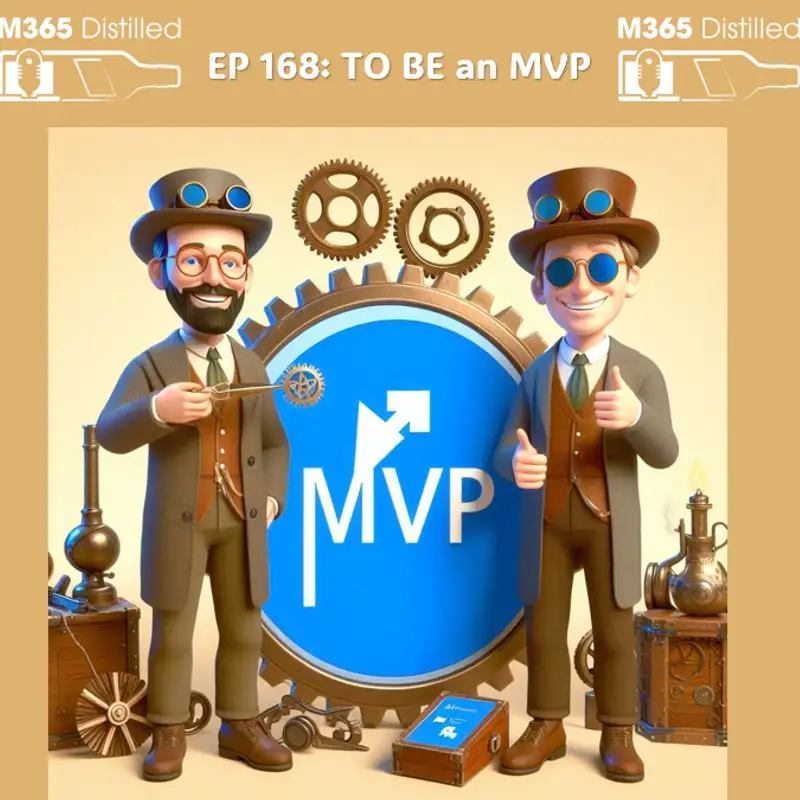
EP 168: TO BE an MVP
Hey. Hey.
Speaker 2:So you know what Kevin McDonald really likes about the MVP program?
Speaker 1:What does... Is it is it like one of those questions? What does Kevin McDonald like about the MVP program? I have no idea.
Speaker 2:We we asked 400 MVPs to give them... What was that? No. No. No.
Speaker 2:Anyway, it's it's the flumadiddle. Flumadiddle. The flumadiddle.
Speaker 1:He likes the flumadiddle.
Speaker 2:Exactly.
Speaker 1:Okay. So if anybody wants to know what flumadiddle means, you need to just message Kevin. It doesn't get enough social messages anyway. Sure. And he will tell you all about it.
Speaker 2:Oh, that's nice. Yes. Nice. Brilliant.
Speaker 1:Yes. Oh, god. So I wonder whether everybody enjoyed the last podcast we did where we sat and drank three, four whiskeys and talked a lot of questions.
Speaker 2:Got some good comments about it. Some people liked it a lot. So we always joke that we do the whiskey tasting at the end because otherwise it would be drunk talk, but maybe we need to revisit that. Maybe we need to start with the whiskey tasting and then do the rest of the...
Speaker 1:Most people know we do the whiskey tasting at both ends.
Speaker 2:Well, we have the unofficial one before we start recording.
Speaker 1:Yes. The practice one.
Speaker 2:Yeah. Yeah.
Speaker 1:Try to make sure you get the glass level. You don't smish your mouth. Exactly. Yeah. The basics.
Speaker 1:Practice. Yeah. Yeah. Yeah. Exactly.
Speaker 1:Rehearsal.
Speaker 2:Yeah. Yeah. Yeah. Exactly. So today, we have one of those nights where we, earlier today, we say, yeah, let's have a podcast.
Speaker 2:Let's do some, recording. And then I arrive here. We have some we have some brilliant food. And then at some point, the question comes, what are we gonna talk about?
Speaker 1:Yeah. Are we gonna talk about flumadiddle?
Speaker 2:Flumadidyl. Yes. Exactly. I think I think that's what my my doctor prescribed to me as well. Some flumadidyl.
Speaker 1:Yeah. A little flumadidyl makes the world go by.
Speaker 2:Exactly.
Speaker 1:It's like teaspoon of sugar.
Speaker 2:Yeah. Or an apple a day. Yep. Yeah. Absolutely.
Speaker 1:Flumadiddle. So
Speaker 2:I was scrolling through LinkedIn to find some inspiration, and, of course, it's beginning of July or, actually, it's half July. And all of my LinkedIn is filled with, all my friends, and acquaintances and people that I vaguely know, but I'm still connected to, all being re...
Speaker 1:What do you
Speaker 2:call that? Renewed. Yes.
Speaker 1:Exactly. All being nude.
Speaker 2:As an as an MVP. Yeah. Which, All
Speaker 1:people you admire and look up to in life. Yeah.
Speaker 2:So congrats to everyone. So we got renewed as well. We did. So that's good news. Was you worried?
Speaker 2:I always get a little worried.
Speaker 1:I mean, looking at some of the people that didn't get renewed, you always kind of think it's a bit of a lottery, but we'd no idea what they filled in on their forms.
Speaker 2:That is that is also very true because I I know a few people that didn't get renewed, and I was really Surprised. Surprised by it.
Speaker 1:Yeah. Right. But let's let's try and... So what we did say was it's MVP time of year. Yeah.
Speaker 1:Let's kind of do something around MVP. We're both quite proud of our MP... MPVPness. Yes. Our minimum viable product.
Speaker 1:Our MVP ness. Our MVP ness. And and then you said your minimum viable. Yeah.
Speaker 2:My minimum viable penis.
Speaker 1:Yes. Alright. So anyway, so this this group of dicks we belong to, beautiful people they are. Alright. Zoe, I do apologize way in advance, but there you are.
Speaker 2:Alright. No.
Speaker 1:But seriously. Okay. Yes. Stop flam dingling around.
Speaker 2:Flam dingling. Okay.
Speaker 1:But we then basically said, let's actually talk about being an MVP and what it means and everything else.
Speaker 2:Exactly. And I said,
Speaker 1:yeah, won't take long because we'll sit there and talk about how cool it is and what we do. So then we decided to ask all the other MVPs that are online at this point in time. So we've got a few of those that we'll cover a little bit later on. Yes. But I think the first thing to talk about is maybe how do you become an MVP and what do you actually have to do?
Speaker 2:Well, first of all, we need to talk about what is the MVP thing. Because sometimes when I talk to people and I say I'm a Microsoft MVP, they'll go like, oh yeah, I need to have that box checked at some point as well. So I need to do that next year. It's it's like going to the doctors or going to the dentist. So, yeah, I need to do that next year as well.
Speaker 2:I'll schedule it on my agenda to become an MVP. So, the Microsoft, or most valuable professional program. It's it's actually an award from Microsoft to say, we like you. You've been very busy.
Speaker 1:But it's a recognition of everybody going over and above what they do on their job.
Speaker 2:Yes. Exactly. It is, a recognition for the things that you do that you're not getting paid to do. Because we're both professionals. We do SharePoint and Teams and all these things from eight to seven, in the evening.
Speaker 2:But next to that, we also do a bunch of other activities like this podcast.
Speaker 1:Exactly. Oh, god. We're even saying the same words now. I wonder whether we've been doing this too long.
Speaker 2:Oh, so it's a recognition, from Microsoft for people that, as you said, go above promoting, explaining, helping... I'll you
Speaker 1:what, let's have a bit of a game out of this for a moment So or I'll add... We'll make a list of all the things that we know people do as an MVP over and above what they normally do. And then I'll tell you one, you say one, and we'll find out who runs out first of all. So I'm gonna go with the easy one, which is of course we speak at community events without getting paid. Sometimes we may get a bit of a hotel room paid for by the sponsors, but we spend a lot of time preparing speeches, coming up with sessions, writing workshops and basically spending
Speaker 2:Hours and hours and hours.
Speaker 1:So anyway, but speaking at community events for no charge.
Speaker 2:Yeah. That's definitely an activity that a lot of people do, and that's also one of the most visible ones.
Speaker 1:I think so. Yeah. Think so. Personal growth ones as
Speaker 2:well. Yeah. For the people at least. And also if I go to... Well, always when I go to a conference, I am definitely...
Speaker 2:Well, I'll definitely look for sessions that are given by an MVP because I know that the quality will definitely be there. So that's that's definitely a good one. Yeah. Okay. So I will, give you an activity that is the least visible, but that is very visible for Microsoft, and that is giving feedback to the product groups.
Speaker 1:Yes. That is very good actually. Yeah. It's good to be able do that. When you get frustrated as a non MVP, that something doesn't quite work right.
Speaker 1:Mhmm. And quite honestly, your complaint goes into a bit of a slow lane. Mhmm. We get to go and poke somebody in the eye if it's really bad. Yes.
Speaker 1:True. But also, if you, are
Speaker 2:working on a project and something is not going right or you stumble into a very specific weird problem, you can work with the... If you bypass the help desk as a non MVP.
Speaker 1:Actually, you don't do
Speaker 2:that. No. No. As a non... I mean a non MVP.
Speaker 2:Yeah. After you pass the the help desk, you can actually get in touch with the product groups to actually, well, work with them to give your feedback on on, what is going wrong, which I think is super important also for Microsoft to, improve their services, but it's not always visual. So I know a few people that got their MVP, and they were practically unknown, by the rest of the, how do you call that, the rest of the group of MVPs. And they got their MVP because they were giving so much feedback to
Speaker 1:my team. I think it's very valuable. I mean, we get some things for being an MVP. So we get certain licenses and certain credits in Azure and that kind of stuff. We can't use them for company stuff.
Speaker 1:But so you get people testing AI, you've got people testing into Fabric, all the new stuff that comes out. And there's some those kinds of people that lock themselves into a dark room between with a glass of water, their laptop and draw the curtains, and then they spend fourteen hours testing something new. And then they'll give a whole read back of, you know, what worked, what didn't work, what could be better. And that stuff, as you say, goes off in the background.
Speaker 2:Yeah. True.
Speaker 1:Yeah. But we also get to see the public side of that, which is attending summit.
Speaker 2:Yes. The MVP summit is probably the biggest benefit?
Speaker 1:Well, it costs us a fortune.
Speaker 2:Well, it it's it's not really a benefit.
Speaker 1:Well, let's explain it. So Yes. A summit is an MVP only event. It is, under non disclosure because we should also say that being an MVP, you do sign a quite solid non disclosure agreement.
Speaker 2:Did you read?
Speaker 1:I have read it.
Speaker 2:Yes. Okay.
Speaker 1:I think it took me five or six seconds. You have to scroll to the bottom.
Speaker 2:Yes.
Speaker 1:Do you suppose to read it? I thought it was just that you scroll to the bottom. Yeah. Yeah. Yeah.
Speaker 1:It makes you scroll to the bottom. Of course. I mean, it's standard nondisclosure stuff. And they will come after you if you make mistakes and publish things you're not supposed to.
Speaker 2:Oh, yeah. Yeah. Yeah. Every year, there are people getting thrown out of No, the no, actually thrown out of the FPP Anyway,
Speaker 1:so what Summit allows us to do is within the Microsoft complex is you get to talk to the production teams and they say, hey, we were thinking of changing this box to be blue. What do you guys think and what sort of problems will we see and how will that work? And so you can have an hour or two talking through all those kinds of things with the guys that are cutting the code. Yes. Exactly.
Speaker 1:And actually trying to work out our best to to plan that out. So, yeah, I think that's a... It is a very good one. Yes. The fact that you can get to do that.
Speaker 1:There's some simple ones. So writing blog posts. That's also quite good. So where you're, you know, pushing and advertising, the Microsoft stuff, you can't do it just by doing this. You don't get your own v by doing just one of these things.
Speaker 1:You tend to have to mix and match.
Speaker 2:Yeah. Yeah. Same category is writing books.
Speaker 1:Mhmm.
Speaker 2:But, yeah, that's kind of same category. We also have, all the online stuff. Yes. All the the webinars, the, the YouTube videos, the TikTok stuff. I know a lady that has been doing TikTok videos around security, around purview and all that.
Speaker 2:Got a massive following. Yep. So, yeah, that's... It's it's... The the whole MVP thing is about carrying the word out, evangelizing, to a...
Speaker 2:To the community and no matter where that community is.
Speaker 1:No, that's true. What's really cool about it is that it is a fully global entity. The network is right around the world. Mhmm. It's really very sort of, because basically everybody, you know, manages Microsoft in that one form or another in...
Speaker 1:Within the MVP community, of course. And that is global. Yep. True. So, yeah, there are some insights, some advantages, the translation stuff that I've been trying to deal with for nearly six months now.
Speaker 2:Yeah. Yeah. But let's let's keep at the activities first, and then we
Speaker 1:can come tomorrow.
Speaker 2:Then we can talk about the benefits of the others.
Speaker 1:Is karaoke an activity you have to be good at?
Speaker 2:Karaoke is not an activity. It might be a benefit. Although I heard one MVP talk about our latest karaoke adventure as being in literal hell. Maybe that was because I was singing,
Speaker 1:probably. But yes. Carrie answered your question. So are there one or two other things that Yeah. Yeah.
Speaker 2:Yeah. So there
Speaker 1:are a few other things. Things that people can get to do then. What are they?
Speaker 2:Mentoring people. Oh, yeah. That's that's a good one. Samples and codes... Well, code examples and and
Speaker 1:Get to a bit imports and stuff.
Speaker 2:Yeah. Exactly. I've I've done a few of those, like some JSON formatting things or other code examples that you might wanna give. And then also improvements to the to the Microsoft Learn docs. Yes.
Speaker 1:That's interesting. They're now starting to statistically check those kinds of things.
Speaker 2:Yeah. It's good.
Speaker 1:Yeah. So they're, this this is sort of becoming a more automated process.
Speaker 2:Yeah. It's good. Yeah. Yeah. I've I've, a few months ago, I've done some add ins for the exchange...
Speaker 2:For some of the exchange pages. Even though I know nothing about exchange, there was this new functionality that's gonna roll out this summer for newsletters in Outlook, and I've improved some of the documentation around that. Nice. Yeah. Most fun.
Speaker 2:Nice. Yeah. So, yeah, I think... Can I think of something else? Well, organizing user groups
Speaker 1:Yes. Is
Speaker 2:definitely one on there as well.
Speaker 1:Volunteering for these events?
Speaker 2:Volunteering at events is definitely a good one as well.
Speaker 1:We did Commsverse TV. So sort of, volunteered within the Commsverse in that community event. Yep. Took our skills along there.
Speaker 2:Yeah. So that's that's a bunch of the activities that you can do. So, what are some of the things that really stand out for you this year that you've done for the community?
Speaker 1:Oh, well there's a few.
Speaker 2:As you said, like the Commsverse TV.
Speaker 1:Yeah, Commsverse TV was rather special, so I have to say that was good. Which you
Speaker 2:can find by the way on YouTube if you search for
Speaker 1:Commsverse 2025, Commsverse TV 2025, you'll see us there. So yes, and that's interesting because it's not just about standing in front of a microphone, it's setting it all up. It was the whole organizing, talking to sponsors, working with other partners in the Microsoft community at those kinds of levels. So yes, that was pretty cool and neat. Speaking at events, so we spent some workshop time
Speaker 2:in Poland.
Speaker 1:And I'm going to be at the Baltic Summit on, I actually had the date out earlier. Ah, end of
Speaker 2:September somewhere.
Speaker 1:So the Baltic Summit is, doing, another event there, workshop. I had it on a piece of paper earlier, but I've lost it.
Speaker 2:But for you it's mainly, it's the podcast. It's speaking at events.
Speaker 1:Events. Yes. Yeah. Yeah. Media stuff.
Speaker 1:So generally, been there. I mean, I do four hours a month of podcasting True. Together with
Speaker 2:nook as
Speaker 1:well for the future talk. So, yeah. So for me, it's really about that and the technology that I know about, my history of sound work and things. Mhmm. So, yeah.
Speaker 1:So that's what I generally do. I don't do many... Much blogs and things nowadays. And I have lots of ideas that I never quite deliver on around YouTube. We did the It Depends, game show
Speaker 2:Yes.
Speaker 1:Last year.
Speaker 2:That was fun.
Speaker 1:Yeah. Wanted to do that again this year, but never quite hang it together. Try for autumn. Yeah. Yeah.
Speaker 1:That was fun. Yes. They were they were fun actually. That that idea really should not die.
Speaker 2:No. Yeah. We might need to blow some more life into that.
Speaker 1:Yeah. Okay. And what about you? Speaking is a big, big part of your community.
Speaker 2:Speaking. Yeah. Exactly. I think I did around 13 conferences last year. Yeah.
Speaker 2:I do a lot of those. But then also, helping out on big conferences like the, m three six five conference in Vegas, for example, manning the, ask the experts boot, things like that, the community, booths. Yeah. And then as I said, like
Speaker 1:Does that make you an expert? Or No. So are you an expert?
Speaker 2:Sometimes. In some In some things.
Speaker 1:Yeah. That's the thing, isn't it? We we don't an expert on everything nowadays. It's too broad.
Speaker 2:No. Exactly. And and we might not know it, but we might know the person that might want... That might know the answer.
Speaker 1:Yeah. That's true.
Speaker 2:So that's... I think that's that's a big one. So, no, definitely, about the podcast speaking, some samples, some some docs that I send in as well, and some feedback sessions as well. Mhmm. I had a few feedback sessions around, Teams, for example, with Microsoft, thinking or thinking about the future of, of the tools, in SharePoint as
Speaker 1:well. You have your
Speaker 2:newsletter every week? Interesting. The newsletter every two weeks, that as well.
Speaker 1:Need to do if they want to be get onto that mailing list for your newsletter?
Speaker 2:Well, the newsletter is in Dutch, just like my
Speaker 1:So you need to be able to speak Dutch, obviously.
Speaker 2:Exactly. Or use AI to translate it. But
Speaker 1:You could use AI to translate it and have both versions.
Speaker 2:Yeah. Well, maybe. But also the, YouTube Yeah. Videos that I do specifically in Dutch for, Belgium and The Netherlands.
Speaker 1:I think that's important because... And kudos for that because it's never gonna be high numbers.
Speaker 2:No. I know.
Speaker 1:But it's a service you can deliver to to local people and Exactly.
Speaker 2:So I... On YouTube now, I've got 290 followers, something like that. And my videos get around... I don't know. Some get 200 or 300 views, which is totally fine Mhmm.
Speaker 2:Because I got really good feedback on that. I I recently had someone in one of the courses that I was giving, and she said, oh, I actually watched all your videos because I'm trying to learn this, and there is just not any non English stuff available. There's nothing in Dutch available, and this is so much more relatable. Cool. So that's Alright.
Speaker 1:Yep. So that's that's how you become an MVP.
Speaker 2:Well, no. That's that's what we do. How do you become an MVP? That's a very good question.
Speaker 1:Okay. So, 10 generally, and we offer to do this for anybody that's interested. Mhmm. You get recommended by another MVP. Yes.
Speaker 1:So there's report out, and you can then get proposed. And that's both good as well because that also benefits people that keep their MVPness.
Speaker 2:Yes. Because that's also an activity that we can do is to bring, onboard new MVPs. So if you think you've got what it takes or you've done a body of work the last twelve months, you can ask an MVP to be proposed. And, we can put that in the system, and that will go to an MVP handler, a regional handler, but that will also go to the product groups, of that specific technology that you work in, and then they will decide, if you are getting enough clout to be in the program. Yes or no?
Speaker 1:Let's not underestimate this process. So that it's not just a name, address, email, blog site name, Twitter account, check, check, check. Okay? They want to understand what you've been doing, what the value of it was, how did the people that you... So you know, how many people read your blog item, how many people attend your training courses, what value do those people get from it.
Speaker 1:It's it's quite an intense process.
Speaker 2:Yes.
Speaker 1:If you're doing a whole year, it's a couple of three or four hours worth of work. Yeah. You don't have to do it in one go. Mhmm. But, but yes, you do need to put it in there.
Speaker 1:Yeah. They also need to say why you want to be an MVP and what you wanna get out of it. Yeah. Exactly. And I think that's a great time.
Speaker 1:But we can... And are more than willing to sponsor you. We're not advertising it. If you know another MVP, by all means do, but we can propose you. Yep.
Speaker 1:But, that's okay. I... I'm actually getting a bit distracted at the moment. The top button of your shirt is undone, and it's turning me on, man.
Speaker 2:Oh, it's showing a little It is. Yeah. Chest
Speaker 1:hair. Yeah. Little chest hair. Oh, okay. It's just...
Speaker 1:It's not that kind of studio here. Okay. Okay. I mean, if the cameras were on, we'd get x rated.
Speaker 2:Ah, okay. So there's then then we shouldn't publish on you... On, yeah, YouTube.
Speaker 1:YouTube and for children.
Speaker 2:There's there's other there's other sources
Speaker 1:for that. Okay. Good. Okay, good. Yeah, yeah.
Speaker 1:So you guys know we get distracted easily.
Speaker 2:Yes, we do.
Speaker 1:Yes. But no, this MVP thing is Yes.
Speaker 2:Now why would you want to become an MVP? What would be in it for you to become an MVP?
Speaker 1:I I think that's a really good question. And I think you need to be the kind of person that, has a strong career. And I don't mean that in terms of I got a great job and I get paid a lot of money or I'd, you know, you've really got to believe that career progression and giving and feeding back the yin and the yang of your work is important to you. So, you know, so you can sit down and put that extra in. If somebody...
Speaker 1:If if you if you work in tech and somebody sits down with you and says, hey, I need to understand this, and you put a time aside and you help them and you enjoy that and you get a lot of satisfaction three weeks later from watching them doing it themselves and having developed, then those I think are the natural MVPs of the world where they're willing to spend time correcting stuff, writing stuff, putting things together, understanding and learning the new technology.
Speaker 2:Yes. So you should be a person that already likes this technology, already wants to talk to everyone about it, and those people would be the natural MVPs. Because I know I've been I've now been working for seventeen or eighteen years, and I've now been an MVP for seven years. Before that, I was also going to conferences, speaking at conferences, writing blog posts, all these things. And if now I just got renewed, but if I wouldn't get renewed, I would still be doing this podcast.
Speaker 2:I would still be flying around the world to talk on all these, conferences. So that's just the thing that I love.
Speaker 1:So who would... Who should not go for an MVP?
Speaker 2:I would say people with a kinda nine to five mentality. People that say, okay. My work's my work, and after my work, I'm I'm... I don't wanna do anything else. That's definitely not the right people.
Speaker 2:People who can't hold a tuna karaoke should definitely not come either.
Speaker 1:So how did you get to be an MDT? That's okay. Actually, it should be anybody that can't hold a tune after they've been drinking for four hours at Cali.
Speaker 2:I am really good at buying people drinks, so that's why they let me that's why they let me tag along.
Speaker 1:Yeah. But but the thing is important. So I'm trying to get to the point where people should not assume that, hey, I did this conference last week, so I should be an MVP. Yeah, exactly. It's about consistency.
Speaker 1:Yeah. It's about spread over a period of time. Yeah. For a year. It's about keeping it up.
Speaker 1:You do have to reapply every year. Yes. Yes. So I think you get eighteen months on your first, depending on your timing.
Speaker 2:And also important is that you need to have one focus area. I recently proposed, someone I... I've known for more than ten years, who is now also leading a user group in in in Denmark or in Sweden, who's doing all the right stuff, so I proposed him. And he got rejected because the first six months of the year, he was mainly doing Power Platform stuff. Then the second half of the year, he was mainly doing SharePoint stuff.
Speaker 2:So that was too inconsistent, so they rejected him for now. But I'm sure he... If All the great people
Speaker 1:get rejected first time around. Maybe. No. They do. Absolutely.
Speaker 1:They do. Okay. Because I did. I got rejected the first time around.
Speaker 2:Okay.
Speaker 1:You did, didn't you? I didn't. Oh, you did or did not?
Speaker 2:I did not. Oh, okay. I got in straight away.
Speaker 1:There you go.
Speaker 2:But I got a little psyched know.
Speaker 1:Yeah. Anyway. But but... No. But it's it's also...
Speaker 1:It's not just a badge of honor to wear, it's a badge you work for. So you've got to be willing to to put the effort and the time in. And it's not just about standing there every ten minutes and saying I've stood there for ten minutes, it's about new ideas, different ways of reaching people, different ways of mentoring people, different sessions. You can't do the same session for the ten years. You've got to develop new training material or community events.
Speaker 1:Actually,
Speaker 2:I know this one guy who has been doing the same session for the last ten years. Yeah. Hans Brendel, you know I love you, man, but... Jeez. No.
Speaker 2:But he's he's talk... He talks about OneDrive, but he talks all the time about OneDrive, and he knows it from inside
Speaker 1:out. Yep.
Speaker 2:And he just has so much knowledge. And every time I go to his sessions, every time I learn new things. Mhmm. So it's amazing. So even you can do you can do the same session for ten years and just tweak it every...
Speaker 2:Once in a while. Perfect.
Speaker 1:But that I think is where you talk about what we talked about earlier about not deviating, that you're focused on
Speaker 2:one thing. Yeah. Exactly. Yeah. Yeah.
Speaker 2:So you are an MVP for
Speaker 1:M v... M three six five.
Speaker 2:Three six five.
Speaker 1:Technical Specialism in SharePoint.
Speaker 2:Yeah. Okay. K. So now I'm I'm, MVP for SharePoint and Teams. So Yes, sir.
Speaker 2:In the m three six five space, which is funny because I was an MVP for Teams, but never for SharePoint. But now I am for SharePoint as well.
Speaker 1:So you're not SharePoint? I know. You wanted to join the greats. I know. There was only two of us.
Speaker 2:SharePoint has been my first love, and it will be my last probably, but I've... I was never an MVP for SharePoint, only for Teams.
Speaker 1:So now there are three SharePoint MVPs in Belgium. There was only two before.
Speaker 2:Can't be.
Speaker 1:No, serious. There was only two, and Nook and myself. Because she got annoyed because she was the only one.
Speaker 2:Come on, and then it looked like...
Speaker 1:Yeah, no, there was only two, but now there are three. The three great presenters and now there are only three MVPs. You can't be.
Speaker 2:Can't be. Be. Let's search.
Speaker 1:Most people just say
Speaker 2:mvp.microsoft.com is a way to find, all the MVPs. So there are about 4,000 MVPs worldwide, but that's not only m three six five. That is
Speaker 1:all the Microsoft friends. Bunch of
Speaker 2:stuff. Exactly. So let's say country. Let's say Belgium. Barbados.
Speaker 2:No. Belgium.
Speaker 1:Oh, let's do Barbados. I like Barbados.
Speaker 2:And then we can say technology area. Shippoint. Oh, we got so many people that I've never
Speaker 1:met And...
Speaker 2:Oh, okay. Cool. And then we go to... Is it gone? No.
Speaker 2:It's just gonna be SharePoint. Right? Yes. Oh, it's actually... Okay.
Speaker 2:SharePoint. And then we got five. Well, we got three, four. We got Anuk. We got you.
Speaker 2:We got Gokhan, who is also an an MVP and an RD. And now it's me.
Speaker 1:Oh. There was only two before. Yeah. Interesting. And Gokhan must have added SharePoint this year because he wasn't there last year.
Speaker 2:Interesting. Okay. Gokhan is indeed m three sixty five for SharePoint. Yeah. Yeah.
Speaker 2:Okay. Interesting.
Speaker 1:You see? What do you say?
Speaker 2:Well done. Well spotted.
Speaker 1:Apologies is the word was looking for. That doesn't matter. It's fine. Yeah. Yeah.
Speaker 1:No. I only knew because Anuk was the only one, then I got in, so that annoyed her. And then, of course, now you've got it. She'll be. Nice.
Speaker 2:Okay. Cool. Cool. Cool. Cool.
Speaker 2:Cool. Cool. Alright.
Speaker 1:And and that kind of makes sense. I mean, it allows them to spread this around. So my guess is if you really wanted to be an MVP and you do generalize, have a look at MVPs in your area and find out what technologies are missing. And if you have those skills, then focus on that area for a year to fill that slot.
Speaker 2:Yeah. Because you can be an MVP in multiple categories. For example, in security and m three six five. Yes. So that's definitely something you can.
Speaker 2:There are a few people that do that. Not too many because it's very difficult to do. It's it's already quite difficult to be an... Or to become an MVP because you need to deliver all that all that extra work. And if you wanna do it then for two extra things, that's a lot of work.
Speaker 1:It is. Yeah. Yeah. Alright. But I think some of them are related.
Speaker 1:They're not two separate top level categories. It's the category m three six five, and then you're specializing in the SharePoint tech.
Speaker 2:Well, that's how how I am for SharePoint and Teams, but you can actually be for two separate
Speaker 1:things as chat about that, so we'll have a look at it because somebody was saying that's not the way it works. If you look at them, you'll find they're in the catalog.
Speaker 2:No. No. The the the chat was about the email that we got, and the email had some weird words.
Speaker 1:Distracting. Yeah.
Speaker 2:Yeah. But because I know people that are MVP for security, so for Purview and Sentinel, but also for m three six five.
Speaker 1:Okay. And
Speaker 2:that makes sense. Example, for the power platform and m three six five, which is also separate. So I wasn't... I know power... No?
Speaker 2:Okay.
Speaker 1:She just dropped for one this year, but she knows why. Okay. She was not focused enough. Okay.
Speaker 2:Yeah. But as I said, it's a lot of work.
Speaker 1:It's a lot of work.
Speaker 2:It's a lot
Speaker 1:of work. Is not just a program Microsoft go, oh, I've got to do MVP this month. I mean, there are active people employed to look after that
Speaker 2:Yes.
Speaker 1:Group of people. It is really important. Yes. Like I said, it's a way... It's the interface between the end users and partners with with incredible knowledge base created by these MVPs.
Speaker 1:So it's not something that you just get and keep forever. You do have to earn it. Mhmm. But the thing is you've got to enjoy it.
Speaker 2:It's true. And it's very important. I mean, what is the benefit for Microsoft to have MVPs?
Speaker 1:I agree.
Speaker 2:I think there there are two things. The first one is getting feedback on what you want to bring out because the people at Microsoft are very knowledgeable, but they don't always have the consultancy experience or the experience with multiple organizations that we have. And on the other hand, it's also us MVPs, how do you say that, amplifying their message.
Speaker 1:Agreed. Repeating the message. Yeah.
Speaker 2:Repeating, amplifying, giving more, examples on how to use these new features Yeah. Things like that.
Speaker 1:I I think it's a a real mix of pure technical things. It's a real mix of people using them and showing you how to use them. It's a mix of instructors. Yeah. There's, we can all call our favorite instructor guy we go to when we need a SharePoint question answered or, it's about organizing events, organizing people, supporting people.
Speaker 1:Yeah. So so we know what it is. That's for certain. Let's find out what we think other people thought of it.
Speaker 2:We send the message out. I made a little list. So there's an, an an MVP, WhatsApp group. If you are an MVP, you're not on the WhatsApp group, let me know. And so we ask the, I don't know, 400 MVPs or whatever moment.
Speaker 2:What the... What what they think the biggest benefits are.
Speaker 1:Well, the top three.
Speaker 2:Yeah. Yeah. And next to the flamididals, of course.
Speaker 1:That's true. All the badges.
Speaker 2:Yeah. All the badges. Yes. Yes. So one of the first things that I wrote down is we're not getting paid.
Speaker 2:We're not getting paid by Microsoft. We're not getting paid by our boss to do the things that we do. We do this for fun. We do this because we like it. We do this because we maybe have a big ego that we want to do something about.
Speaker 1:But I think it's important as well because it also means we're not biased.
Speaker 2:True. We can
Speaker 1:be as honest and open as we like. Yes. And in some respects, well, we can give you an example. When we was at summit where you're literally talking to the guys cutting the code for the product and they're trying to work out where to go next, you get a lot of people whining and complaining about stuff that just doesn't work the way it's supposed to work. Yes.
Speaker 1:You get some people that go over the top on the whining complaining. And some people that just say, hey, you know, thank you very much, it's all great and we love what you're doing, and that kind of stuff. Somewhere in the middle, there's a point where you have to be critical of what you see to get it improved. So it is an important part of it. Need to be Yes.
Speaker 2:Can we can be very honest and very Yes, exactly. So we do this, we're not getting paid, although we wear head to toe branded Microsoft gear all the time.
Speaker 1:That we now have to buy.
Speaker 2:That we now also have to buy. Yes. Exactly. Yes. Yes.
Speaker 1:That's fine.
Speaker 2:Because as an MVP, what do we get? We get a little glass statuette with a ring, and every year that you that you be an MVP, you get another yearly ring. You can get... You get a, like, like, a
Speaker 1:I can't believe we went past that one without a joke. It's it's not very Office 365 Distilled that Microsoft give you another ring every year and we don't come up with a joke. Let's move on.
Speaker 2:Yeah. So we get a...
Speaker 1:It's really munching joke.
Speaker 2:I know.
Speaker 1:And we don't wanna go down to that level of munching.
Speaker 2:Not again. No. No. So we get a certificate, and we get, meetings with the product groups. That's that's about it.
Speaker 2:So is that once a year
Speaker 1:People said they said, oh, no.
Speaker 2:No. No.
Speaker 1:No. That's what I'm excited about. No. No. That's what I'm excited about.
Speaker 2:What do they get excited about? About, Kevin said, a connection to an international group with similar levels of geekiness aka my tribe. I think that is that is definitely the case. Somebody said swag, but we we used to get some swag every now and again. At summit, we get some swag like a T shirt.
Speaker 2:I remember that my first summit when I went, I got, these OneDrive socks and SharePoint socks. Those were super cool. We got bags, but, yeah, we we don't get a lot
Speaker 1:of swag anymore. It counts against their c o two.
Speaker 2:True.
Speaker 1:So there's a lot more cutting back. We heard that when we did Commsverse TV. Yeah. I think the mugs that we got from Lenovo were really, really clever. Yes.
Speaker 1:So we're drinking out of some really wonderful metal enamel mugs that used to say Lenovo in big red letters on it, and then my dishwasher Yeah. Decided to remove them. It was quite funny. But the label underneath that tells you not to dishwash, it's still on.
Speaker 2:Yeah. Alright. So, what's next? We have, what what people said as a benefit is, the meetings with the product groups. So access to information, through the product groups, but also being able to deep dive into the product direction, and share early feedback.
Speaker 2:Yeah. But also, understanding more of the why along with the what. And I think that is very important because every... Once in a while, Microsoft brings out some feature where a lot of people go like, why? What problem does this solve?
Speaker 2:And when you actually hear from Microsoft, this is why we've done it, then it actually makes more sense.
Speaker 1:It's another valuable part of the process that reporting back that we do, because they don't honestly know the way everybody uses every product and the way it's it's done. True. Yeah. And so then we do get to to understand those different ways.
Speaker 2:Yeah. But also the other way around. Like, they bring out something and then we don't always understand why that's being built until we actually
Speaker 1:True. Yeah. So Viva.
Speaker 2:Yeah. Oh,
Speaker 1:okay. I was just being honest and open. Transparent.
Speaker 2:Uh-huh. Uh-huh. Okay. So, yeah, definitely the meetings with the product groups, everyone thinks that they're super helpful. Yes.
Speaker 2:I I always like to, go on there as well and then also just monitor the chat because the chat is where all the all the fun stuff happens, where everyone's just blasting off questions. That's that's always a lot of fun.
Speaker 1:Yeah. No. It's pretty cool. Alright. Well, look.
Speaker 1:Let's, we could go down this because a lot of repeating of things. I think we've we've covered most of it, but let's not... Let's just finish off with the social aspects of this. So... Oh, you wanna say one more thing.
Speaker 1:The fingers in the air.
Speaker 2:Yeah. The fingers in the air. I... So we asked a question to the group, and we got the the whole default bunch of stuff back like, oh, yeah. Product group interactions and having the stickers and the the whatever.
Speaker 1:We Okay. Can with you guys. Blah blah blah.
Speaker 2:Yeah. Exactly. Hanging out with you, Marijn, letting you buy us drinks, stuff like that. But what Josefins Denmark said, I thought that was actually... See, that's one of the things that I never thought about.
Speaker 2:Josephine is a Scandinavian. I don't know which country she's from. Young lady, professional. And she said, well, it helps me being taken more seriously by my senior peers. So I I thought I thought that was that was very, how do you call that?
Speaker 2:Very... That was something I didn't think about because, of course, I'm not a lady and, of course, I'm never being taken serious. But I think that was a very valid remark. So if you're a young person, that might help you, be taken more serious by your customers, the rest of the company, and and all that. So I think that was an important
Speaker 1:It's a level of affirmation that you're up to speed on the technology associated with everything as opposed to... That you
Speaker 2:know what you're talking about.
Speaker 1:Yeah. But quite honestly, without being an MVP, I'm not sure if it brings there. But if it gives you a level of confidence because you have the support of your peers, then I think that is incredibly valid. And and for especially young people that come across as inexperienced, they pick this shit up a lot quicker than than I do and it comes out so fast nowadays. Yes.
Speaker 1:You know, the technology and the changes. There's changes Microsoft made just for the heck of it. I had one this morning, blew my brains. So, man, this is a meeting. This is in Outlook.
Speaker 1:So the button is here. It's where I can just sit there and go, yes, I accept the meeting. No, it's moved now, it's in the top right hand side of that little Yeah, yeah. Alright, so stuff like that just happens, True. You So, so those kinds of things do happen, but at least you get the peers to be able to sit there and think about them, and you also get the ability for everybody to go, why the hell did you move the button guys?
Speaker 1:You know, but I'm sure somebody someday works it out. But yes, having your peers around you to help you and motivate you, I think is really important. Oh god. You are thinking again or indigestion, one or the other.
Speaker 2:Yeah. No. No. Okay. Good.
Speaker 2:Yeah. Sure.
Speaker 1:You can't decide how far to go down this road you've started on.
Speaker 2:Exactly. Yes. Now you know that. Exactly.
Speaker 1:Yeah. I know that. Okay. Now let's just meet this head on for a little minute or two. So there are women in technology groups because they feel they need to have that support and they do because there is such thing as a glass ceiling.
Speaker 1:It exists.
Speaker 2:Mhmm.
Speaker 1:You'll find that 95% of the MVPs in whatever size, genre, country you're coming from, they're all there to help each other. All there to actually support each other. They're all there to tell somebody that they're stupid because of what they said. Those kinds of things. And we're...
Speaker 1:Yeah, you can have a group of people, male or female, black, white, pink, green, whatever. You're talking tech, you're having a drink, you're socializing, and nobody cares. Yeah. It's it's it's there because of the technology and what we bring into the community, and that's why that...
Speaker 2:Oh, Absolutely. But I mean, if you're working in a company, I mean, I've... I can still remember when I started out in the SharePoint team.
Speaker 1:Get to the age where you start to forget that. So, just onto it. Keep hold of it there. It's important.
Speaker 2:Yeah, exactly. Me talking at conferences also was a way to validate my level of expertise to the rest of my team. Like, I'm I'm doing this. Yep. So I can definitely imagine that becoming an MVP or an MCT or something else actually serves as a as a stamp, as a proof of of recognition of, the community to say you're doing a a great job.
Speaker 2:You know what you're talking about, and that that can help you within the company to to grow within the company.
Speaker 1:No, I think it's true. I think it is valid in the company, in companies. But I think part of it is just I'm making the effort. I mean, even even in a day to day job, they want you to go overboard to do things. They want you to hang around there if you need to.
Speaker 2:We want to pay you as least as possible, but we want you to do work the most as possible.
Speaker 1:Yeah, Sunday morning, we were doing a changeover, so we were moving some file servers around. Mhmm. Really?
Speaker 2:It was
Speaker 1:three hours online. Okay. And why are you laughing?
Speaker 2:No. Cool. Cool. I'm happy that it's finally happening.
Speaker 1:Oh, Yeah. Yeah. Yeah. Okay. Yeah.
Speaker 1:Good. So the that maybe that is another interesting podcast.
Speaker 2:It is. Yes. Because I feel like we've been talking for quite some time.
Speaker 1:No. We've been... We're about forty five minutes. Oh, really? Okay.
Speaker 1:That's good. But but I think it's that sort of community spirit you have at work is the same thing you have outside work with your externals as part of being True. Within this community. Yeah. We should also point out there are other communities.
Speaker 1:There are AWS communities. There are Google communities. There are IBM and tech communities. So it's not particularly unique. And I have no idea whether it's the largest or the smallest or inter...
Speaker 1:Associated. It's one of the questions.
Speaker 2:What Jeff Deeper always says is that this is the best community.
Speaker 1:Of course it is.
Speaker 2:It's the m three sixty five community is the best one.
Speaker 1:It is. But the number of sessions that go off around the world is amazing. Have you noticed that the conference... Traditional conference periods are expanding? Oslo is in the middle of December.
Speaker 2:It's always been end of November. It's always been End of November.
Speaker 1:Well, after
Speaker 2:after Ignite. So Ignite moves back in the year.
Speaker 1:So Okay. Oslo moves back. I am noticing that there there are more of them now trying to vie for space because so those areas are starting to to wider. I mean, was... It's a ridiculous number of community days that happened that supported by MDPs Yeah.
Speaker 1:Around the
Speaker 2:So community... The the... Was it collab days?
Speaker 1:Collab days.
Speaker 2:AMS, community days, all these Expert's Lives is now growing as well.
Speaker 1:Yeah. Here we So time for a whiskey.
Speaker 2:Time for a drink.
Speaker 1:Have something rather interesting.
Speaker 2:Not just a drink.
Speaker 1:Not any drink. Did you get any tasting notes for it?
Speaker 2:I didn't look for any tasting notes.
Speaker 1:The microphone down again. Just glued this top on so nobody steals it.
Speaker 2:I love the color on this. So we are drinking Dalmore, and the Dalmore bottles are always beautiful because it's got the the the deer on. But this is the Dalmore, quartet. It's got a four cask finish. And I will tell you what those finishes are sometimes.
Speaker 2:So there is, the Dalmore always does, lots of sherry as well. So Dalmore is Scottish high in the Highlands, high up in the Highlands. When I was there a few years ago driving by, they were actually closed, so we couldn't go in there. But the four finishes that they have is they have, of course, first fill bourbon, which is pretty normal. Then they have the Apostoles Palo Cortado and the Matusoleum Oloroso cask, which is both a sherry cask.
Speaker 2:They're both from the Bodegas Gonzalez Biats. And then the last one, which I think makes this very unique, is a Cabernet Sauvignon wine cask. Interesting. Interesting.
Speaker 1:I have different casks according to ChatGPT.
Speaker 2:Different casks. Okay.
Speaker 1:Ex bourbon, Ola Rosso, Pedro, Jarmines, and port pipes. And port pipes? Okay. Cherries.
Speaker 2:Port pipes is the the whiskey that you generously gave me is also is from a port pipe. So what does it say what does it say on the bottle or on
Speaker 1:the There's not a lot on the label, unfortunately.
Speaker 2:No. What does say on the bugs? Yes. Because we have conflicting information.
Speaker 1:Bestowed in, the king of Scotland in 1263. That's not point. The Dalmar, fifty years. The quartet, refined in fragrancy, go more beautifully orchestrated, first fill ex bourbon. Yeah.
Speaker 1:Exclusive, Mattesoleum and Apostolate, is that one you said, French Cabernet Sauvignon cask finishes. Good.
Speaker 2:Awesome. Yes.
Speaker 1:So what I got was wrong. So chat GPT was incorrect. Holly, you're wrong. There you go.
Speaker 2:Thank you, my friend. So the first thing is of course the beautiful color.
Speaker 1:It is good. It's nice and dark from the pork pipes or from the Cabernet
Speaker 2:Sauvignon.
Speaker 1:So this whisky I was travelling out to Commsverse on the boat because I had all the equipment in the car And I... If you go on the boat from Dieppe... No? Not
Speaker 2:Dieppe? To Calais?
Speaker 1:No. It was Dover. Calais. It's the other one that's close, not Calais next to it. It's before Oh,
Speaker 2:the say Brugge. The... No. It's not.
Speaker 1:It doesn't matter. It's the place. Mhmm. But they they have the whiskies there. And I saw this Dalmore triple.
Speaker 1:And I thought, oh, that's a nice idea. And then I get to the next shelf. There's a Dalmore quartet.
Speaker 2:Yes.
Speaker 1:And there's no price on it.
Speaker 2:Of course. Of
Speaker 1:course. I know. So, yeah, I was thinking so. But I but I really liked the idea of it from what I read. Mhmm.
Speaker 1:There's a few of these coming out now where you can actually get them spreading over forty years. They take a little bit of the ten, twenty, thirty, and forty years. Which we have. Cask we did. Yes.
Speaker 1:Mhmm. The Deanstones? No. Maybe. Maybe.
Speaker 1:Maybe. Okay. But it doesn't matter. I have got one upstairs. Yep.
Speaker 1:The Chronicles.
Speaker 2:Yeah, which was a mix of 20, 30, 40 and 50 year olds.
Speaker 1:Don't know who was Dean Stoon Chronicles, but I might be wrong. That's okay.
Speaker 2:Anyway, yes.
Speaker 1:That's fine. So this is a Donald, so that's where it came from. But I looked, lifted the lid and I looked inside and saw that beautiful red brown sheen and thought, one has to give this a try.
Speaker 2:Yes. So it is a travel retail exclusive? Yes. Yeah.
Speaker 1:Yeah. Some of those are really very unusual. I know. The week of Pete is only available as a travel exclusive. Is it?
Speaker 1:I Or the one I want anyway, the the 16 year old one or whatever it was.
Speaker 2:Oh, maybe.
Speaker 1:Yeah. Okay. Okay. Yeah. Okay.
Speaker 1:So So the advantage is you get a full liter bottle.
Speaker 2:Yes. Yes. That's true. Yeah. Yeah.
Speaker 2:Yeah. Because I have a... What's that? Islay whiskey. That's It's 19.
Speaker 2:The 16 year old is so good. The Lagavulin. I've got a ten year old Lagavulin, which is also
Speaker 1:travel anniversary edition.
Speaker 2:Yeah. Travel exclusive. And I've got a few others.
Speaker 1:Yeah. Yeah. We can't resist.
Speaker 2:I have a website where you can buy also travel Exclusives. Exclusives from there.
Speaker 1:That sounds exclusive.
Speaker 2:Yeah. Well, my ass, not that much. But... Okay. So, the...
Speaker 2:You wanna know the
Speaker 1:No. I wanna taste it. Enough. Tell me... Oh, go on.
Speaker 1:Tell me what we're gonna get on the nose.
Speaker 2:Vanilla, roasted coffee beans, red grapes, plums, raisins, dark chocolate, black peppercorns, rich toffee hazelnuts, white and balanced.
Speaker 1:Wow. That is red berry richness.
Speaker 2:Yes. Absolutely. I do get a little bit of that coffee, but then coffee with lots of milk. I... Yeah.
Speaker 2:Okay. And then the mouthfeel would be sherry influence, of course, being the Dalmore with a sharper, slightly tannic red wine edge, raisins, lots of licorice and pepper, tangy ginger and clove, gingerbread, wine soaked pears, then dark chocolate and orange peels, and red fruit jam with a long spicy finish. It's a beautiful finish.
Speaker 1:Mhmm. Christmas cake on the finish. Definitely. Nice. Cinnamon.
Speaker 2:It is a brilliant drink.
Speaker 1:It is. It's as Yeah. Anything.
Speaker 2:Mhmm. It doesn't have an h label, but it's super
Speaker 1:Doesn't eat it.
Speaker 2:Yeah.
Speaker 1:Oh, and the pepper.
Speaker 2:I would say an h label is just for people that feel insecure.
Speaker 1:I think so too. Yeah. The pepper on the finish after about thirty seconds is pretty intense.
Speaker 2:Yeah.
Speaker 1:That's very, very good.
Speaker 2:Yeah. I get chocolate. I get orange. So I get that typical dark chocolate with, the orange bits in it. You got a chocolate.
Speaker 1:Orange, I think.
Speaker 2:No. No. Something warm and and
Speaker 1:It's definitely a winter whiskey.
Speaker 2:Yeah. Maybe not with the 30 degrees that we've been having all week. Yeah. But still brilliant drink.
Speaker 1:The mouthfeel is amazing. Yes. The oiliness Smans around your hand... Your mouth.
Speaker 2:Mhmm. Brilliant drink. So if you're ever taking a boat flying, doing whatever you want, and you find the Dalmore, the quartet, we are very... How do you say that? We are We recommend evangelizing.
Speaker 1:Yeah. Yeah. Evangelizing.
Speaker 2:Exactly. So maybe we should do another... When did we do that last time? The the... Our whiskey awards.
Speaker 2:Oh yeah.
Speaker 1:We haven't done that for ages.
Speaker 2:Yeah. Maybe we should do that again at some point. Yeah. Like the best whiskeys we've had all year. Yeah.
Speaker 2:Maybe we should go to Barcelona first then to go to the whiskey bar, the whiskey bar.
Speaker 1:The whiskey. Yes. Yeah. There's a new bigger place than where we were there.
Speaker 2:Yeah. Sorry.
Speaker 1:They had amazing food.
Speaker 2:Sorry?
Speaker 1:They had amazing food. They had vogonestrias made with partridge... With pheasant's eggs. Oh. Were just freaking delicious.
Speaker 2:Oh, okay. Cool.
Speaker 1:Yeah. Mhmm. I love this. With a temperature water, you might want to try and put a drop in. The creaminess of that coffee, just put it straight out.
Speaker 1:Oh, yeah. Do it that way. Wise move. That was pretty amazing. I like that.
Speaker 1:I forgot I... I've I've drunk... I've had so many different bottles pass through this house just recently that I kind of drank it when it first came in. I think we tasted it before a podcast, and I haven't drank it since.
Speaker 2:Nice. Spices. Lots of spices when
Speaker 1:you put it away and rest. Yeah. That's very, very good.
Speaker 2:I think I prefer without the water. So do I.
Speaker 1:I think it's a better with a full bodied whiskey. Mhmm. Yep. Alright. Quite an interesting podcast.
Speaker 1:So just to to close down guys, if you do wanna ask any questions around what it's like to be an MVP, what it's required, if you are even thinking about it, don't hesitate. We're quite willing to answer questions and all that kind of stuff.
Speaker 2:Absolutely.
Speaker 1:We can't... It's interesting that because MVPs are under nondisclosure, most of the m p... MVP groups tend to be intra rather than extra simply because of that, nondisclosure and the risk and the things that they... That we end up talking about. Yeah.
Speaker 1:So don't hesitate to reach out. And if you're an MVP in America and you wanna talk to, sorry, if you're a prospective MP in The US and you wanna talk to, we can put you in touch.
Speaker 2:True.
Speaker 1:Yes. We have access to all of them. Yes. Good. Awesome.
Speaker 1:Cool. Nice subject. I liked it a lot. Good. Community based.
Speaker 1:A community based podcast.
Speaker 2:Mhmm.
Speaker 1:Yep. Awesome. Yeah. And the last word is, I'm gonna say hi and bye. Marijn is gonna try and remember the word that Kevin said we had to put into the podcast.
Speaker 1:Let me look that up. Oh, it's a fail. Oh, no. It's a fail. Is it flamadunkle flamadunkle or...
Speaker 1:Flamadiddle. Flamadiddle. Yes. I can imagine why diddle is in Kevin's mind, but let's not go there. All right guys, so yes, that just shows what the community is.
Speaker 1:They also gave us three words that we had to put into this podcast. Yes. And which was just the kind of fun that you have as a group. It's pretty amazing. I've had some great experiences over the years socially.
Speaker 1:Yeah. For... I mean, karaoke seems to be a thing. It is. Yes.
Speaker 1:Which is really... We party hard. And certainly, we've tasted a few whiskeys by... Within the MVP communities. True.
Speaker 1:I guess because we meet regularly.
Speaker 2:Yes.
Speaker 1:That's good. So if you wanna join the community, you would be very, very welcome. It would do your career, no harm, but you gotta be willing to work. You gotta be willing to help out. Mhmm.
Speaker 1:And if that's something you enjoy doing, then you're welcome. So Steve Dalby signing off, passing over to Marijn to say
Speaker 2:Sharing is scaring, flumadillo.
Creators and Guests